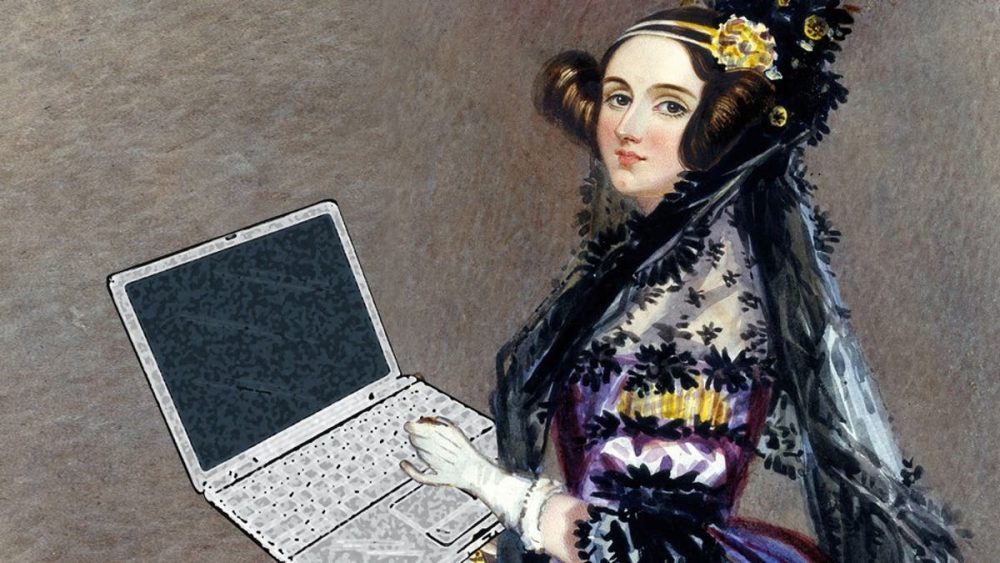


For instance, 34 percent of the workforce in science, technology, engineering, and math (STEM) are female as of 2022, around half of the share of women professionals in the social sciences (65 percent). Ada Lovelace, computer pioneer Ada Augusta King, Countess of Lovelace (1815-1852) is credited for creating one of the first published computer algorithms. While the program was never really tested since Babbage failed to complete the machine, and some have criticized her actual role in the development of computer programming considering Babbage himself had developed his own programs, it was believed that she saw the potential of the Analytical Engine to conduct operations beyond numbers. Nonetheless, recent attempts such as those done by Jim Randell and Sinclair Target went on to run her program using modern computers. Both found what could be considered as early computer bugs, although their analysis assume that they might have been typos rather than errors in Lovelace's original programming. This in addition to the International Day of Women and Girls in Science, which is observed on February 11 by virtue of a United Nations General Assembly resolution. The Mark I is an electromechanical computer which began computing operations for the US Navy Bureau of Ships in 1944. Her later work on FLOW-MATIC, the programming language used for the electronic Universal Automatic Computer I (UNIVAC I), is believed to have contributed in the creation of common business-oriented language (COBOL) in 1959. Read more in our articles including "5 Women in Tech you should know about" and "Dell intros 2015 PC monitors, 5K resolution and curved display in tow".

March 8 has been observed as International Women’s Day by the United Nations since at…
Mar 8, 2022Dell today announces its 2015 lineup of computer monitors. The next-gen displays comprise of the…
Dec 12, 2014
Everything Apple Announced at WWDC 2026: New Siri AI, iOS 27, macOS Golden Gate, and…
Jun 9, 2026
When it comes to OPPO’s budget-friendly options, it’s hard to beat what the new A6…
May 16, 2026
OPPO has released three new models recently: the standard Reno15, the more affordable Reno15 F,…
Apr 22, 2026
The new Infinix NOTE 60 Pro 5G is out, and this guy is a VERY…
Apr 21, 2026For instance, 34 percent of the workforce in science, technology, engineering, and math (STEM) are female as of 2022, around half of the share of women professionals in the social sciences (65 percent). Ada Lovelace, computer pioneer Ada Augusta King, Countess of Lovelace (1815-1852) is credited for creating one of the first published computer algorithms.
While the program was never really tested since Babbage failed to complete the machine, and some have criticized her actual role in the development of computer programming considering Babbage himself had developed his own programs, it was believed that she saw the potential of the Analytical Engine to conduct operations beyond numbers. Nonetheless, recent attempts such as those done by Jim Randell and Sinclair Target went on to run her program using modern computers. Both found what could be considered as early computer bugs, although their analysis assume that they might have been typos rather than errors in Lovelace's original programming.
Our coverage of computer science includes: "5 Women in Tech you should know about"; "Dell intros 2015 PC monitors, 5K resolution and curved display in tow"; "Everything Apple Announced at WWDC 2026". Each article provides unique insights and information.