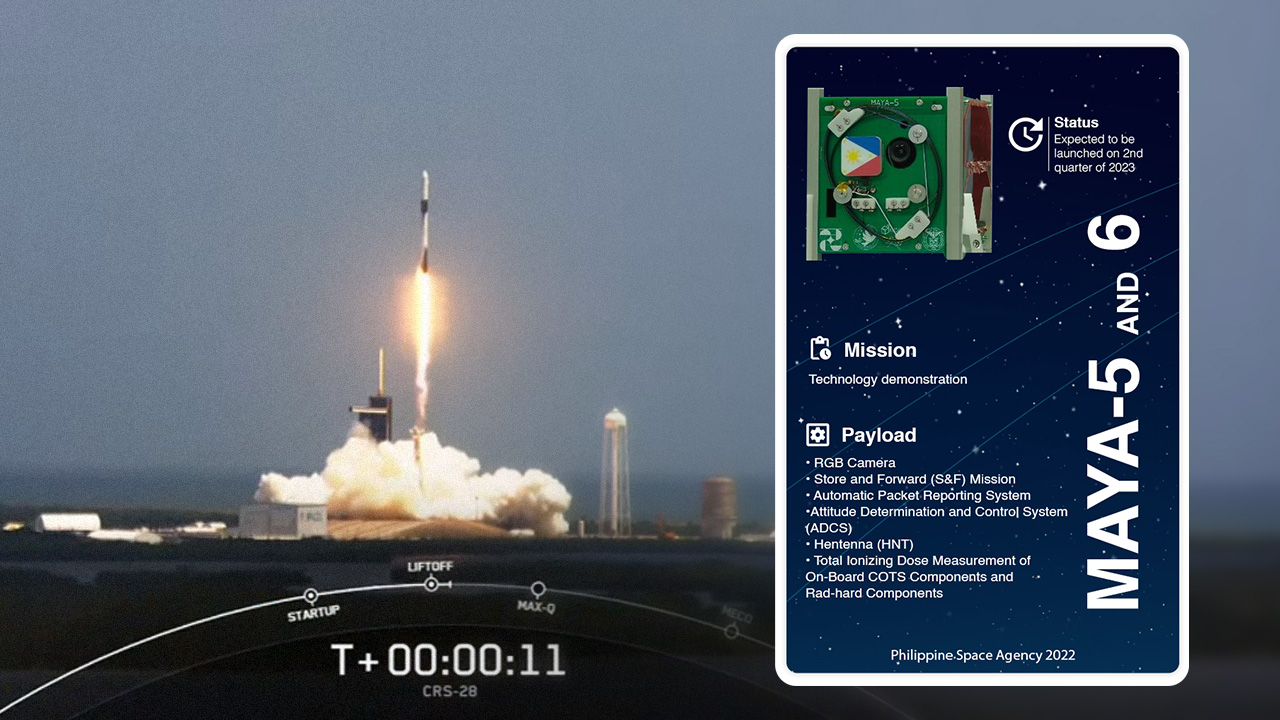


The Philippine Space Agency (PhilSA) successfully launched two locally-built cube satellites (CubeSats)—Maya-5 and Maya-6—to the International Space Station (ISS) via the SpaceX Falcon 9 while on its 28th commercial resupply mission on June 5, 2023 at around 11:47 PM PST. According to the space agency, the Maya-5 and Maya-6 CubeSats were created as a technology demonstration and educational platform developed for remote data collection using Store-and-Forward (S&F) Mechanism. [caption id="attachment_338976" align="alignnone" width="1080"] Maya-5 and Maya-6 | Image/ STAMINA4Space[/caption] The said mechanism involves collecting data and then storing it until the satellite passes over a ground station, at which point the data is forwarded to the station for analysis. Maya-3 and Maya-4, which were the first cube satellites made by Filipinos, were launched to the International Space Station in August 2021 and returned to Earth a year later. The Electrical and Electronics Engineering Institute (EEEI) of UPD's Master of Science (MS) or Master of Engineering (MEng) program's nanosatellite track was also developed in partnership with Japan's Kyushu Institute of Technology (Kyutech), with DOST's Science Education Institute (DOST-SEI) providing scholarship support. The Philippine Space Agency (PhilSA) recently launched SIKAP+, which stood for the Space Infrastructure, Know-How, and Applications Acceleration through Promotion and Training project, in aims to expand scientific research and cooperation among Asian nations. Read more in our articles including "PH launches Maya-5, Maya-6 cube satellites into space" and "PH to teach other nations on space tech and best practices".

The Philippine Space Agency (PhilSA) successfully launched two locally-built cube satellites (CubeSats)—Maya-5 and Maya-6—to the…
Jun 13, 2023
The Philippine Space Agency (PhilSA) recently launched SIKAP+, which stood for the Space Infrastructure, Know-How,…
May 29, 2022
ASUS has officially launched the ExpertBook Ultra in the Philippines, its new premium business laptop…
Jul 2, 2026
Mapúa Education Group has launched what it describes as the Philippines’ first group-wide AI fluency…
Jul 2, 2026
QR Ph accounted for 55% of total payment volume processed by PayMongo merchants in the…
Jul 2, 2026
Sony has announced that it will stop releasing new PlayStation games on physical discs starting…
Jul 2, 2026The Philippine Space Agency (PhilSA) successfully launched two locally-built cube satellites (CubeSats)—Maya-5 and Maya-6—to the International Space Station (ISS) via the SpaceX Falcon 9 while on its 28th commercial resupply mission on June 5, 2023 at around 11:47 PM PST. According to the space agency, the Maya-5 and Maya-6 CubeSats were created as a technology demonstration and educational platform developed for remote data collection using Store-and-Forward (S&F) Mechanism.
[caption id="attachment_338976" align="alignnone" width="1080"] Maya-5 and Maya-6 | Image/ STAMINA4Space[/caption] The said mechanism involves collecting data and then storing it until the satellite passes over a ground station, at which point the data is forwarded to the station for analysis. Maya-3 and Maya-4, which were the first cube satellites made by Filipinos, were launched to the International Space Station in August 2021 and returned to Earth a year later. The Electrical and Electronics Engineering Institute (EEEI) of UPD's Master of Science (MS) or Master of Engineering (MEng) program's nanosatellite track was also developed in partnership with Japan's Kyushu Institute of Technology (Kyutech), with DOST's Science Education Institute (DOST-SEI) providing scholarship support.
Our coverage of space technology includes: "PH launches Maya-5, Maya-6 cube satellites into space"; "PH to teach other nations on space tech and best practices"; "ASUS ExpertBook Ultra now available in the Philippines". Each article provides unique insights and information.