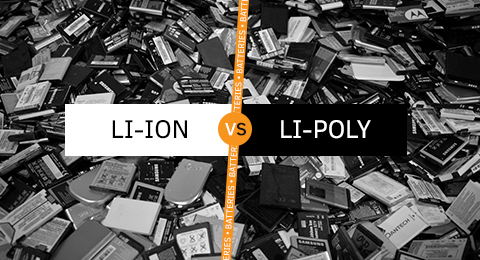

You've probably noticed that they also differ in composition: There are those that are built with Lithium-Ion (Li-Ion) and those with Lithium Polymer (Li-Poly). Lithium-Ion (Li-Ion) Then came Lithium-Ion, a type of battery in which lithium ions move from the negative electrode to the positive electrode during discharge and back when charging. Lithium Polymer (Li-Poly) Lithium-Ion Polymer, more commonly known as Lithium Polymer (also abbreviated as LiPo, Li-Po, but we're using Li-Poly in this article), were first introduced in the 1970s. It is a rechargeable battery of lithium-ion technology in a pouch format. As a result of being flexible and lightweight, Li-Polys carry lower energy densities, suffer less cycle counts, and are more expensive to produce -- the cost-to-energy ratio is higher than that of Lithium-Ion. The Xiaomi 15T comes with 5,500mAh Li-ion Polymer battery with 67W HyperCharge. Read more in our articles including "Battery 101: Intro to Li-Ion and Li-Poly" and "Smartphones Under P10,000 | Q2 2026".
Batteries come in all sizes. Some are small and sleek, while a few others are…
Feb 3, 2015
It’s that time again when we round up the latest smartphone launches here in the…
Jun 26, 2026
A new school year means new projects, research papers, presentations, and online learning tasks. Whether…
Jun 14, 2026
With the announcement of the Xiaomi 17T series today, those hoping to upgrade from last…
May 29, 2026
Inflation is now (May 2026) at 7.2%, electricity rates at Php14.33/kWhr, and gas prices through…
May 28, 2026
GCash has expanded its in-app help tools and security features to address a growing number…
May 22, 2026You've probably noticed that they also differ in composition: There are those that are built with Lithium-Ion (Li-Ion) and those with Lithium Polymer (Li-Poly). Lithium-Ion (Li-Ion) Then came Lithium-Ion, a type of battery in which lithium ions move from the negative electrode to the positive electrode during discharge and back when charging.
Lithium Polymer (Li-Poly) Lithium-Ion Polymer, more commonly known as Lithium Polymer (also abbreviated as LiPo, Li-Po, but we're using Li-Poly in this article), were first introduced in the 1970s. It is a rechargeable battery of lithium-ion technology in a pouch format. As a result of being flexible and lightweight, Li-Polys carry lower energy densities, suffer less cycle counts, and are more expensive to produce -- the cost-to-energy ratio is higher than that of Lithium-Ion.
Our coverage of lithium ion polymer includes: "Battery 101: Intro to Li-Ion and Li-Poly"; "Smartphones Under P10,000 | Q2 2026"; "Best Budget Tablets for Back-to-School 2026 | Under P10,000". Each article provides unique insights and information.