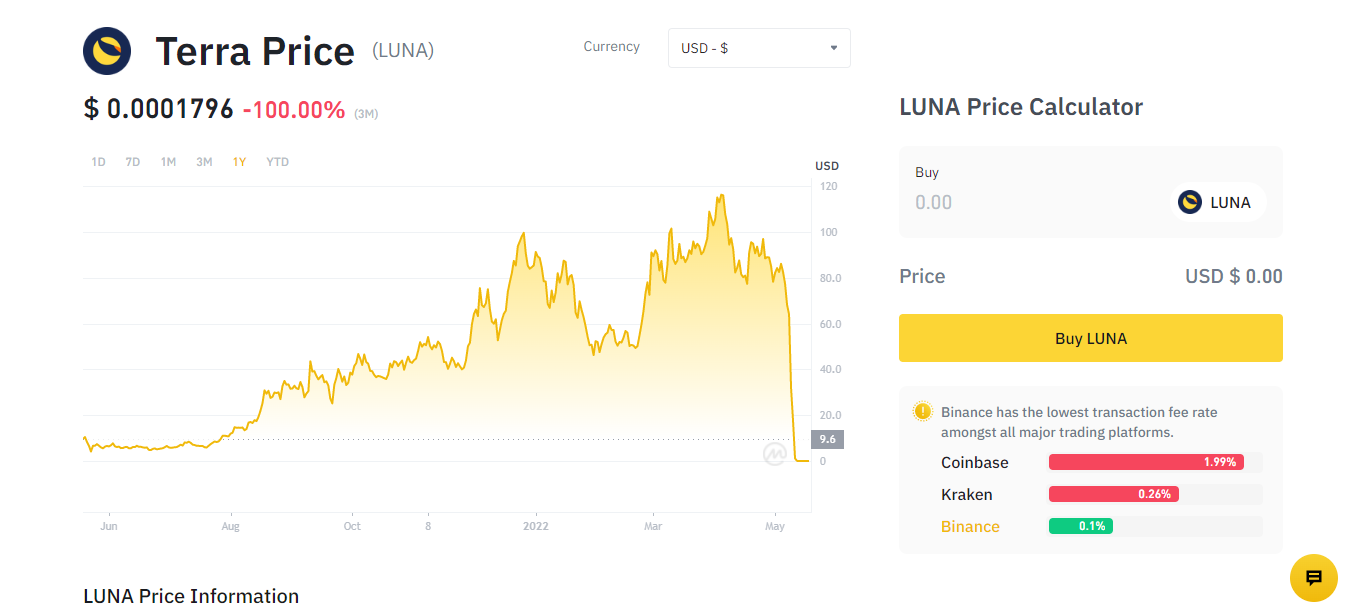


The crash of "stablecoin" TerraUSD (UST) and LUNA, backed by the largest algorithmic stablecoin platform Terra, took the global cryptocurrency market by storm. Introduced in 2019 by Evan Kereiakes, Do Kwon, Marco Di Maggio, and Nicholas Platias, Terra's promise was to be a "price-stable and growth-driven" cryptocurrency. In addition, the Terra design was supposedly rewarding for steady growth with low volatility, a theory expected to maintain stable mining demand and optimize usability. In this case, what props the stablecoin UST is the native Terra cryptocurrency LUNA. Last week's meltdown, however, showed that Terra had not only fallen short of its promise as a sort of "holy grail" that provides stability in the volatile crypto market, there appears to be signs that the history of previous recoveries cannot apply anymore this time around despite the recovery plan to reset the network to 1 billion tokens. So that is eventually what triggered [the crash]." The collapse also prompted critics who have firmly believed in Terra being another type of Ponzi scheme. The point is, nobody is too sure Some would like to attribute the misfortune of the Terra ecosystem to a supposed financial attack, involving massive trades that forced depegging. In relation to this, another perspective would be that stablecoins like Terra are designed to fail in the first place, and algorithmic stablecoins in particular were not as consistent as they present themselves to be. Read more in our articles including "Crypto Explainer: Why LUNA and UST crashed?" and "2022 Nissan Terra launches in the Philippines, priced".

The crash of “stablecoin” TerraUSD (UST) and LUNA, backed by the largest algorithmic stablecoin platform…
May 19, 2022
Nissan has officially launched the new Nissan Terra in the Philippines. The new Nissan Terra…
Sep 2, 2021
With Nissan’s explosive increase in sales in 2018, they continue to impress with the Nissan…
Feb 23, 2019
The new Nissan Terra is here in the Philippines!
May 28, 2018
Coming in hot in the entry-level segment is the new Infinix HOT 70, and for…
Jun 25, 2026
The TECNO POVA Curve 2 5G has arrived. It’s a slim, lightweight phone, and yet…
Jun 12, 2026The crash of "stablecoin" TerraUSD (UST) and LUNA, backed by the largest algorithmic stablecoin platform Terra, took the global cryptocurrency market by storm. Introduced in 2019 by Evan Kereiakes, Do Kwon, Marco Di Maggio, and Nicholas Platias, Terra's promise was to be a "price-stable and growth-driven" cryptocurrency.
In addition, the Terra design was supposedly rewarding for steady growth with low volatility, a theory expected to maintain stable mining demand and optimize usability. In this case, what props the stablecoin UST is the native Terra cryptocurrency LUNA. Last week's meltdown, however, showed that Terra had not only fallen short of its promise as a sort of "holy grail" that provides stability in the volatile crypto market, there appears to be signs that the history of previous recoveries cannot apply anymore this time around despite the recovery plan to reset the network to 1 billion tokens.
Our coverage of Terra includes: "Crypto Explainer: Why LUNA and UST crashed?"; "2022 Nissan Terra launches in the Philippines, priced"; "Nissan Terra's Hot Limited Edition Color". Each article provides unique insights and information.