
Apple has officially introduced the MacBook Neo, and on paper it looks like a simple move.
A cheaper MacBook. A new entry point into the Apple ecosystem.
 But if you take a step back and really analyze what Apple is doing here, the story becomes much more interesting.
Because this device might not necessarily disrupt the laptop market today. The real disruption might happen five years from now.
The MacBook Neo comes with a 13-inch Liquid Retina IPS display, running at a 60Hz refresh rate and capable of reaching around 500 nits of brightness. 8GB + 256GB Base model. Basically a stripped down version of their Macbook laptops.
Those numbers might sound familiar if you’ve been following Apple’s lineup for years. Apple tends to keep its displays consistent in terms of quality, even when it positions a product at a lower tier.
What makes this device interesting is the processor.
Instead of using a traditional M-series chip, the MacBook Neo is powered by the Apple A18 Pro chip, a processor originally designed for Apple’s mobile devices.
Now, at first glance, some people might raise an eyebrow.
“Wait, an iPhone chip inside a laptop?”
But if you’ve been following Apple Silicon since the beginning, this actually makes a lot of sense.
Apple’s mobile chips have been incredibly powerful for years. In many ways, their performance can already compete with the early M-series chips, especially when it comes to everyday workloads like browsing, editing documents, coding, or light creative work.
And that’s really the point of this machine.
It’s not designed to replace the MacBook Pro lineup.
It’s designed to introduce more people into the Mac ecosystem.
But the interesting part isn’t really the specs.
The interesting part is what happens to this machine over time.
The Entry-Level Laptop Market Has a Problem
To understand why the MacBook Neo could become disruptive, you need to look at the current state of entry-level laptops.
Most laptops in the PHP 20,000 to PHP 30,000 range tend to follow the same formula.
- They’re usually made of plastic.
- The hinge quality isn’t always great.
- Trackpads can feel inconsistent.
- And battery life often becomes a concern after a year or two of usage.
It’s a compromise that many buyers have simply learned to accept.
I’ve personally experienced this many times.
One of the very first laptops I owned, I think this was almost 20 years ago — was a compact entry-level machine.
At first, it worked fine.
But eventually, like many budget laptops, the hinge started to give up.
You open the laptop.
You close it.
Open again.
Close again.
After repeating that cycle hundreds or thousands of times, something eventually cracks.
The hinge becomes loose.
The plastic casing starts to show signs of stress.
And once that happens, the experience of using the laptop slowly deteriorates.
That’s a very common issue with entry-level laptops.
With MacBooks, that kind of problem is extremely rare unless the device has been dropped or physically damaged.
And with the MacBook Neo, Apple still chose to use an aluminum chassis.
That alone already changes the expectations of what an entry-level laptop can be.
Because if you look at most Windows laptops in the same segment, aluminum construction is still very rare.
The Things Apple Still Does Well
Even if the MacBook Neo still costs more than some Windows laptops today, Apple retains several advantages that consistently show up in real-world usage.
Build Quality
Most entry-level laptops rely heavily on plastic construction. (Like Literally!)
But with the Neo Apple opted to use aluminum, which not only feels more premium but also tends to age better over time. (unless you drop it!)
Trackpad Experience
This is something many people underestimate until they actually use a MacBook.
Even today, the MacBook trackpad remains the gold standard.
Windows laptops have improved significantly over the years, but many still struggle to match the consistency and precision of Apple’s trackpads. Like 90% of the time I don’t use a mouse when I’m on a mac.
Although, the trackpad if the Macbook Neo will not have that haptic feedback but the fact they still made it similar with the old Macbook Pro’s that you can click anywhere is still surprising.
Battery Life
Battery life has always been one of the strongest selling points of Apple Silicon.
For example, my daily driver right now is a 14-inch MacBook Pro M2 with 32GB of RAM and 1TB of storage.
Even today, that machine can last almost an entire day of work without needing to be plugged in.
And when I previously used a MacBook Air M1, the experience was also impressive and has longer battery life plus it doesn’t heat up.
If I was just doing basic tasks like writing, browsing, or light editing, the battery could stretch across almost a whole day, sometimes even longer depending on the workload.
That kind of battery efficiency is still difficult to find in many entry-level Windows laptops.
Why the M1 Still Matters Today
Another interesting observation is the longevity of Apple Silicon machines.
Even today, many of my colleagues and friends are still using MacBook Pro laptops powered by the M1 chip.
And this is despite the fact that Apple has already released multiple newer generations of chips.
You now hear about M2, M3, and even discussions about M5-class chips.
But here’s the reality.
Most people don’t upgrade simply because something is newer.
They upgrade when their current machine can no longer keep up with their work. (Yup! this is me.)
Plus let’s be honest most of us won’t buy a 6 figure laptop unless we know it will ROI for us. Correct?
The M1 series already established a gold standard when it comes to performance and efficiency.
For many users doing tasks like:
- Basic video editing
- Programming
- Productivity work
- Content creation
The M1 MacBook still performs extremely well.
It handles those tasks without breaking a sweat.
The only time newer chips start to make a noticeable difference is when you enter extremely demanding workloads like AI model training, advanced machine learning workflows, or heavy professional production environments.
But for the majority of users, the improvements between M1 and newer chips are mostly incremental.
And remember, the M1 launched about five years ago.
Today, those machines have already depreciated significantly.
What used to be a six-digit laptop can now be found in the five-digit price range.
Yet performance-wise, it still behaves like a flagship device.
And that’s exactly why the MacBook Neo becomes interesting.
The Real Story Is Depreciation
Let’s look at a real example.
When the MacBook Air M1 launched in the Philippines, the base model was priced at around PHP 55,000 – PHP 58,000.
That was the official launch price.
Fast forward about five to six years later.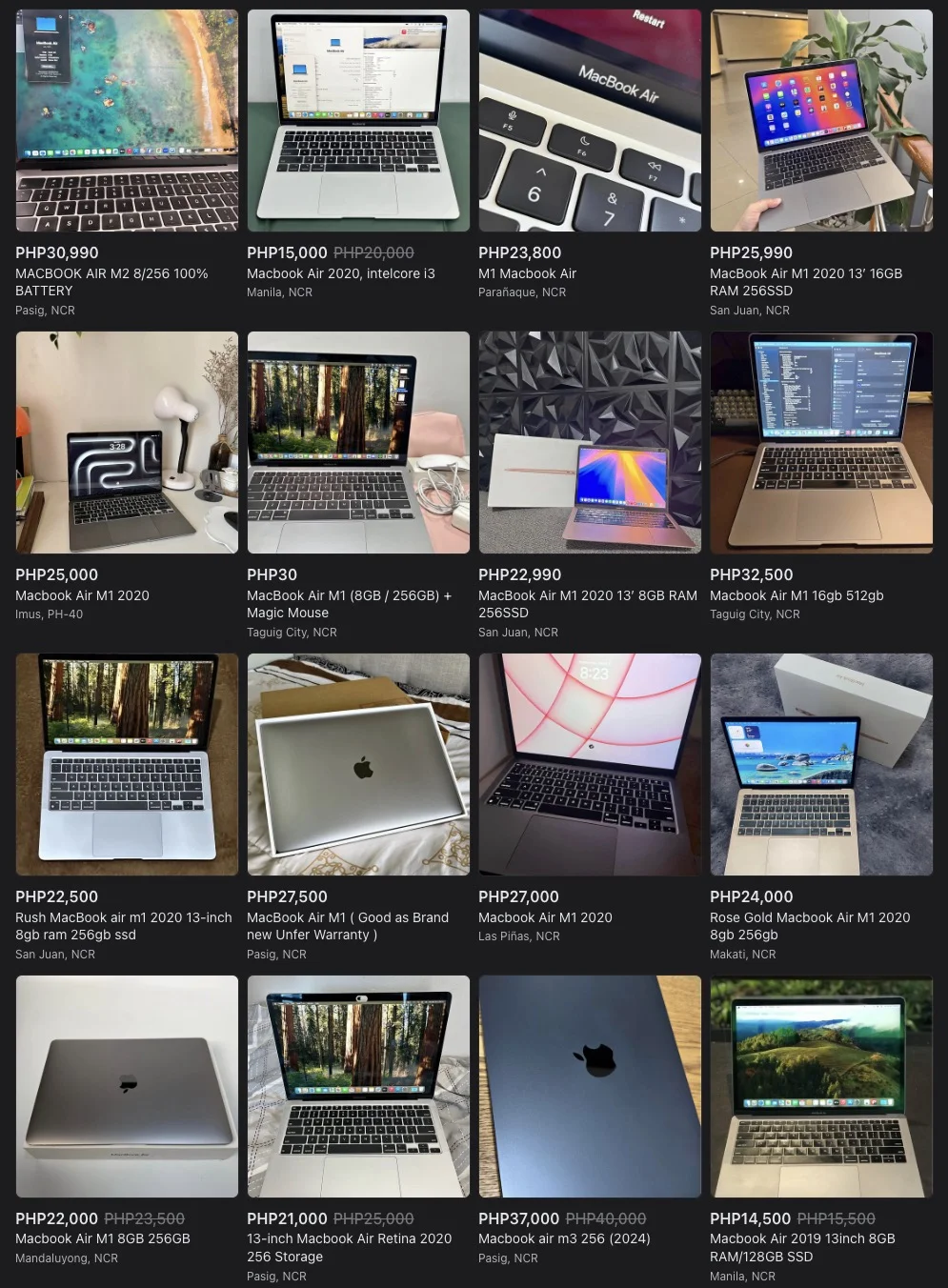 You can now find second-hand units selling for roughly PHP 22,000 to PHP 24,000.
That’s almost 60% depreciation.
Now imagine applying the same pattern to the MacBook Neo.
If the Neo launches somewhere around PHP 35,000 to PHP 45,000, then in about five years it could realistically appear in the second-hand market for PHP 15,000 or even less.
Now think about that for a moment.
A real macOS laptop.
With Apple Silicon efficiency.
With aluminum build quality.
At a price point that competes with entry-level laptops.
That’s where the disruption begins.
The Chromebook Problem
Right now, many schools and institutions rely heavily on Chromebooks.
The idea behind Chromebooks is simple.
They’re affordable.
They’re easy to manage.
They’re built primarily for web-based workloads.
But over time, many organizations have started realizing their limitations.
Chromebooks are great for browsing. (That’s it! no more, no less)
But beyond that, the experience starts to feel limited.
They’re not quite tablets.
They’re not quite full laptops either.
Because of this, some schools have started shifting back toward full laptops or tablets with desktop environments.
Now imagine what happens when thousands of MacBook Neo units start appearing in the second-hand market several years from now.
Students could suddenly have access to:
- A real desktop operating system
- Excellent battery life
- Premium build quality
- Reliable performance
All at a price that previously belonged only to entry-level laptops.
Another good example of this pattern is the iPhone 6.
Even years after Apple stopped producing it, the iPhone 6 continued circulating in the market. In fact, even until recently, you could still find people buying one for roughly PHP 2,000 to PHP 2,500.
And for many users, that was already enough.
It might not have been the latest iPhone, but it was still an entry point to the Apple ecosystem. They could still experience iOS, access Apple services, and use many of the same apps that newer devices supported.
That’s something Apple has consistently been good at, long-term software support.
Even older devices sometimes receive updates or compatibility improvements just to keep certain services working. There have been cases where Apple pushed updates to older iPhones mainly to maintain support for things like iMessage and core services.
So when you look at the MacBook Neo through that same lens, the long-term picture becomes clearer.
Because years from now, when these machines start appearing in the second-hand market at much lower prices, they won’t just be cheap laptops — they’ll be affordable gateways into the Mac ecosystem, just like what the iPhone 6 eventually became for many users.
What About Gaming?
One thing I intentionally didn’t focus too much on here is gaming.
Yes, there are ongoing discussions about Apple improving gaming support on macOS.
There are even rumors and industry conversations suggesting that Apple might eventually optimize its ecosystem further so that top-tier AAA games could run properly on Apple Silicon machines.
But personally, I’m not expecting too much in that area.
Not because Apple can’t do it.
But simply because that’s not how I use my MacBook.
For me, a MacBook has always been a productivity machine.
- It’s where I write articles.
- Where I code.
- Where I edit content.
- Where I do the majority of my daily work.
Gaming was never really part of that equation.
And to be fair, that’s also where Windows laptops still shine.
Even entry-level Windows laptops can technically run PC games.
Maybe not at the highest settings, but at least the compatibility exists.
The Windows ecosystem simply has a much larger gaming library and stronger developer support in that area.
With MacBooks, yes, you can still play games.
But you shouldn’t expect that most PC games will be fully compatible.
But again, that’s not really the main point of this device.
Because for the majority of MacBook users, the laptop is about productivity, reliability, battery life, and getting work done.
And in those areas, MacBooks have always been extremely strong.
Apple Is Playing the Long Game
Another reason Apple can create something like the MacBook Neo today is because of Apple Silicon and supply chain control.
Back when Apple depended on Intel processors, they didn’t have the flexibility to experiment with this kind of product positioning.
Now that Apple designs its own chips and controls the entire hardware-software integration, the company has far more freedom in how it builds its products.
This allows Apple to create devices that balance performance, efficiency, and pricing in ways that weren’t possible before.
And historically, Apple has always been a company that thinks long-term.
They’re not always chasing short-term market wins.
Sometimes they’re setting up moves that only make sense years later. (Well, not all wins they still have flop products IMO! if you know what I mean **wink**)
Looking Beyond the Launch
Right now, the MacBook Neo might simply look like Apple’s newest entry-level laptop.
Some people will still argue that Windows laptops offer better value today.
And in some cases, that might be true in the short term.
But if you look at the long lifecycle of Apple devices, a different picture begins to appear.
Because in a few years, when these machines start circulating in the second-hand market at sub-PHP 20,000 prices, we might suddenly see a generation of students, creators, and everyday users gaining access to the Mac ecosystem.
And when that happens, the MacBook Neo might end up becoming far more disruptive than it initially appeared.
Because the real disruption might not be happening today.
It might be happening five years from now.






0 Comments
Leave a Reply