
Samsung’s Galaxy A-series are now competing heavily in the mid-range price segment due to its good price-to-specs ratio. In our previous specs comparison, we took the Huawei P30 Lite against the Galaxy A50 and showed that the latter won by offering more advantages in terms. So, this time, we’re putting the same Galaxy device beside the crowd favorite’s Pocophone F1 and see which one has the upper hand in this comparison. Let’s start!
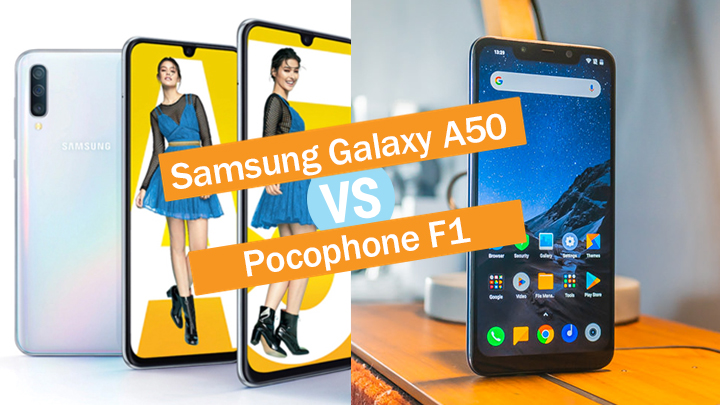
Here are their detailed specs:
| Specification | Samsung Galaxy A50 | Pocophone F1 |
|---|---|---|
| Display | 6.4-inch FHD+ 19.5:9 sAMOLED Infinity-U display @ 1080 x 2340 px | 6.18-inch 18.7:9 Full HD+ display @ 2246 x 1080px |
| Glass Protection | Corning Gorilla Glass 3 | Corning Gorilla Glass (version not specified) |
| CPU | Samsung Exynos 9610 2.3GHz octa-core | Qualcomm Snapdragon 845 2.8GHz octa-core |
| GPU | Mali-G72 MP3 | Adreno 630 |
| RAM | 6GB RAM | 6GB |
| Storage | 128GB | 64GB/128GB |
| MicroSD | expandable via MicroSD (dedicated) | expandable via MicroSD up to 256GB |
| Rear Camera | 25MP f/1.7 AF + 5MP f/2.2 FF + 8MP f/2.2 FF triple rear cameras with LED Flash | 12MP f/1.9 + 5MP f/2.0 dual rear cameras |
| Front Camera | 25MP f/1.7 front camera | 20MP f/2.0 front camera |
| SIM | Dual SIM (nano) | Dual-SIM (nano, hybrid) |
| LTE | 4G LTE | 4G+ VoLTE |
| WiFi | Wi-Fi 802.11 a/b/g/n/ac | Wi-Fi 802.11a/b/g/n/ac 2x2 MIMO |
| Bluetooth | Bluetooth 5.0 | Bluetooth 5.0 |
| GPS | GPS, A-GPS, GLONASS, GALILEO, BDS | GPS, A-GPS, GLONASS, Beidou |
| 3.5mm audio port | yes | yes |
| Biometrics | - in-display fingerprint sensor - AI face unlock | - rear-mounted fingerprint sensor - AI face unlock |
| Port | USB Type C | USB Type C |
| OS | Samsung One UI (Android 9 Pie) | MIUI for POCO (Android 8.1 Oreo), upgradeable to Android Pie. |
| Battery | 4000mAh Li-Po battery w/ 15W fast charging | 4,000mAh battery w/ QC 3.0 |
Here are the advantages of each smartphone:
- Larger screen size
- Dedicated microSD card slot
- Higher main camera resolution
- Wider rear camera aperture
- Higher front camera resolution
- Wider front camera aperture
- Better performing CPU
- Better performing GPU
- 2×2 MIMO support
- Longer battery life
The Galaxy A50’s display has the upper hand in this category mainly due to its screen size. Its AMOLED panel is also good because it produces darker blacks and brighter whites while the IPS one gives more natural colors.
Note: AMOLED panels are prone to screen burn-in while IPS panels consume more power. Read our display guide here.
Performance-wise, it’s a complete landslide victory for the Pocophone F1. No one still beats this device in this price point due to its flagship chipset even if it’s last year’s. Check out our benchmark scores if you’re still not convinced.
| Benchmark | Samsung Galaxy A50 | Pocophone F1 |
|---|---|---|
| Antutu Benchmark | 136,262 | 264,977 |
| PCMark | 5,675 (Work 2.0) | 7,427 (Work 2.0) |
| 3DMark | 1,277 (SSE - OpenGL ES 3.1) 1,395 (SSE - Vulkan) | 3,252 (SSE – OpenGL ES 3.1) 2,706 (SSE – Vulkan) |
| GeekBench 4 | 1,709 (Single-Core) 5,671 (Multi-Core) | 2,475 (Single-Core) 9,004 (Multi-Core) |
| Videoloop Test | 16 Hours | 19 Hours |
The Galaxy A50’s AnTuTu benchmark score is only half of what the Pocophone F1 has which means that the latter has a faster speed and better gaming capability.
As for camera performance, the Galaxy A50 has a triple rear camera setup with a higher main resolution and wider aperture than the Pocophone F1’s dual camera configuration. We’ve yet to know which one has a better photo quality, but you can check out our sample photos for the latter here while you can check the former in our video review below.
Lastly, the Pocophone F1’s battery life is longer than the Galaxy A50 based on our test. Overall, the former is a better choice if you are fond of traveling and don’t want to deal with frequent charging even on the road.
Here are the prices of each smartphone:
- Samsung Galaxy A50 – PHP 17,990
- Pocophone F1 (6GB + 64GB) – PHP 17,990 (PHP 14,990 starting April 16, 2019)
- Pocophone F1 (6GB + 128GB) – PHP 19,990 (PHP 16,990 starting April 16, 2019)
Overall, if you are into watching videos, dedicated microSD card slot, mobile photography, go with the Galaxy A50. However, if you want faster performance, better gaming experience, and longer battery life, pick the Pocophone F1.
If I were to pick, I’d still choose the Pocophone F1 because of its flagship performance. How about you guys? What do you think of this comparison? Let us know your thoughts in the comments section below.



can you elaborate the said ads found in any xiaomi phones?
does lte band of poco supported with our network?