
Since the very first time we’ve had a power station like the EcoFlow, we did not have a lot of use for it except as a ultra high-capacity power bank during trips. In the last couple of years, as power stations become more powerful and capable, the possible uses became more apparent and the more frequent we find ourselves using it (from once or twice a month up to almost every day).
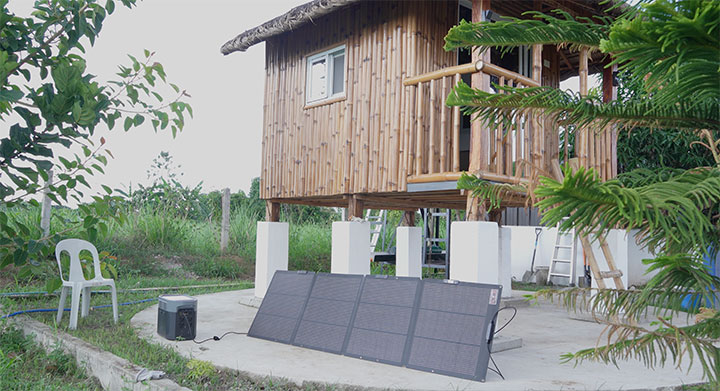
The EcoFlow DELTA 2 Max is a high-capacity portable power station with a 2,048Wh LiFePO4 (Lithium Iron Phosphate) battery, supporting over 3,000 charge cycles.
At 50 lbs (22.7 kg), it is not lightweight, and the retail price is higher than the entry-level models. However, for users needing reliable, high-output portable power with fast charging and long battery life, the DELTA 2 Max is a good option.

With a ton of features and capability, the DELTA 2 Max is designed for users who require substantial, reliable energy storage for a variety of scenarios, including camping, overlanding, RVing, off-grid living, and emergency home backup.
As one who uses an EcoFlow portable power station for the past 3 years, let me give you a closer perspective how this device started out as nice-to-have during the occasional out of town trips to an essential equipment for daily use.
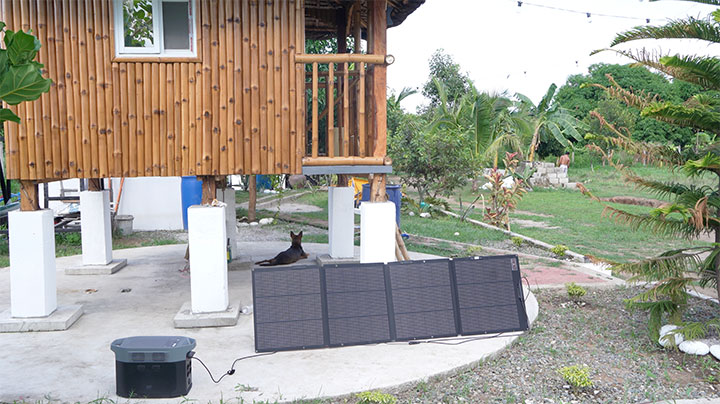
In this review, we’re specifically using the EcoFlow DELTA 2 Max with NextGen 220W Portable Solar Panel.
DELTA 2 Max: Output and Ports
The DELTA 2 Max has a maximum output of 2,400W but can also support appliances with up to 3,100W power requirements using the X-Boost proprietary technology (in X Boost mode, EcoFlow only supports heating devices).

You can plug up to 13 devices simultaneously on the DELTA 2 Max, including 4 AC outlets. There are four (4) USB-A ports, two of which are fast charging; two USB Type-C ports, each one has a 100W charging capacity; one (1) car power output (12.6V, 10A, 126W max); and two (2) DC5521 output ports (12.6V, 3A, 38W max per port).

With the plethora of charging options, the DELTA 2 Max can practically handle any device or appliances (at least 99% of the time) you plug into it – whether we’re talking about air conditioners, microwave oven, water pump to power tools like a circular saw, welding machine or impact drill (Note: may vary according to their specific power requirements).
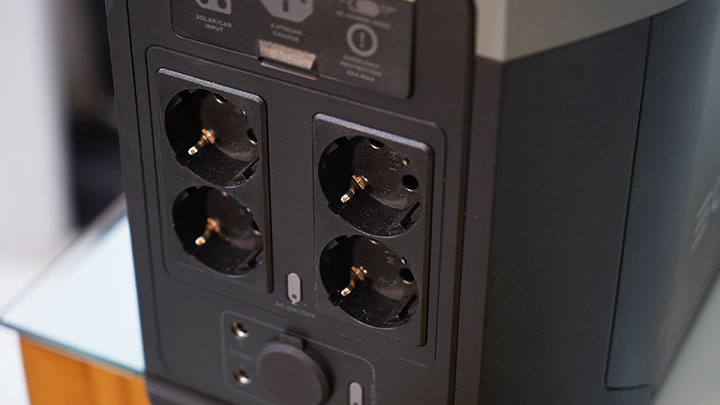
The four (4) AC outlets have a total of 2400W power supply with up to 4800W of surge power.
Charging the DELTA 2 Max
Just like the other EcoFlow power stations before it, one of the biggest features I absolutely liked about this is the support for multiple charging options.
Plug it into the AC wall outlet and you can fully charge a drained power station in under an hour and a half (1800W AC charging at 91 minutes). This fast charging feature has saved us multiple times when we discovered the unit hasn’t been charged before we drive off on an out of town trip – half full in under an hour, which is just as quick as getting our vehicle prepped while loading all the other bags, camping equipment and gears inside.

Now, if you did have the time to actually charge it at home and you are already on the road – the EcoFlow DELTA 2 Max also comes with a 12V/24V car charging adaptor. The car charger is equally fast so you’ll get the power station amply charged even before you reach your destination.
Lastly, the DELTA 2 Max comes with a built-in port for solar charging and using the EcoFlow 220W portable foldable solar panel, you can practically recharge the DELTA 2 Max almost anywhere where you can get a good sun light.
In one of our field tests using the 220W solar panel, we were getting a harvest output of about 188W while connected to the DELTA 2 Max and the monitor was showing around 8 to 9 hours to fully charge the battery.
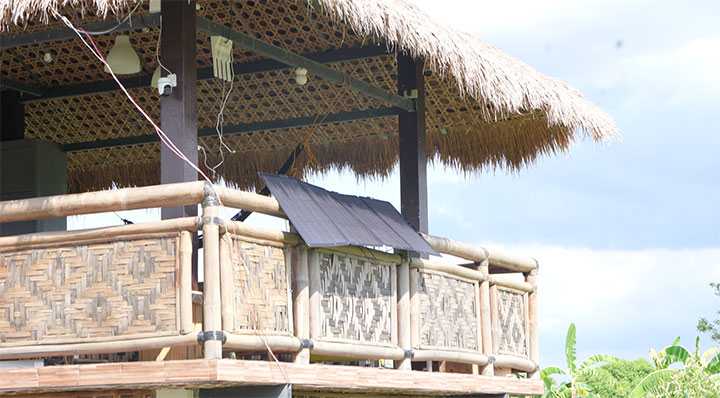
However, the DELTA 2 Max supports a maximum of 1,000W charging and if you have a solar panel with that capacity, it can basically charge the unit in just 2.3 hours or just a little over 2 hours and 20 minutes. Not bad!
Of course, if you have the EcoFlow 220W solar panel with you, it should be enough to re-charge the DELTA 2 Max the whole day even if you are off the grid.
To save on electricity bills, you can simultaneously charge the DELTA 2 Max from the AC outlet AND the solar panel with the solar charging taking priority. That way, you still get the fast charging feature (80% in 43 minutes, when the photovoltaic input meets the 1000W input) and somewhat save a little bit of electricity cost.
With support for 3,000 charge cycles, it will take more than 10 years of using it everyday until the capacity drops to 80%. That’s already on the extreme side so you can rest assured that the DELTA 2 Max will actually last you a lifetime of regular use.
Charge Capacity
The DELTA 2 Max has a capacity of 2048Wh which can go up to 6KWh by adding two extra batteries (add 2 DELTA 2 Max Smart Extra Batteries to get to 6,144Wh).
Now that you have a fully charged EcoFlow DELTA 2 Max power station, how much or how long can you power up your electronics and appliances? Well, it depends on the type and consumption rate, but to give you an idea, here’s a typical computation for different devices:
Electric Fan (40W) = 43 hours
TV (110W) = 15 hours
Refrigirator (120W) = 14 hours
WiFi Router (10W) = 174 hours
LED Bulb (5W) = 410 hours
Samsung Galaxy S25 Ultra = 94 times
Apple iPhone 16 = 132 times
Macbook Air M4 = 38 times
* Note: Computations stated above do not factor in conversion losses.
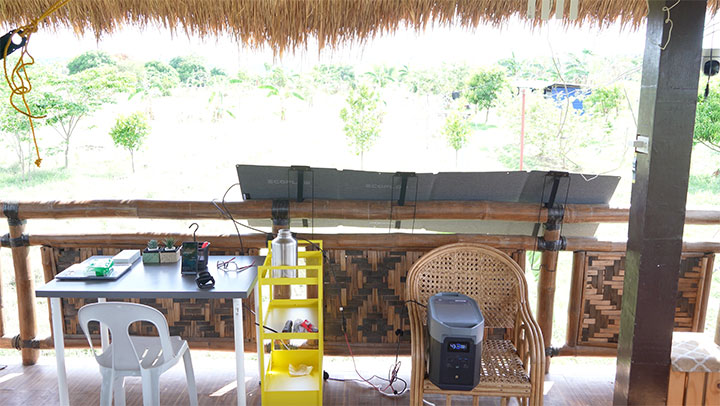
In the course of a few months, we managed to get our EcoFlow to run two (2) LED bulbs and a WiFi router in our off-grid farm in New Clark City from dusk til dawn without any issues. That’s on top of the occasional charging of a few smartphones once or twice that same night.
Connectivity
The DELTA 2 Max includes Wi-Fi and Bluetooth for remote monitoring and control via the EcoFlow app. Simply download and activate the EcoFlow app and add the DELTA 2 Max wirelessly (within a few feet) and you should be able to see the charging time, battery remaining and input power (AC, solar) and output power.
It also supports UPS functionality for automatic backup during power outages. The battery is expandable with additional EcoFlow smart batteries, increasing total capacity up to 6,144Wh.
EcoFlow NextGen 220W Portable Solar Panel
There’s an option to get the DELTA 2 Max with a NextGen 220W Portable Solar Panel. That way, you can recharge the unit even if you’re camping in the outdoors and have nothing to plug the DELTA 2 Max.

The 220W is the base model of the NextGen Portable Solar Panel (bi-facial) with the higher 400W as the top variant. Using this single panel, you can expect to re-charge the DELTA 2 Max at a minimum of 9.3 hours, assuming you get maximum exposure to sunlight. This is almost the same readings we got when we used the solar panel with the DELTA 2 Max, although at that time, we were only getting around 188W of solar output.
Nevertheless, the DELTA 2 Max supports up to 1000W of solar charging. It comes with a dual solar charging port with a max of 500W each. That means charging time can be as fast at 2.3 hours at full power.
Where we use the EcoFlow
In the last couple of years that we’ve used an EcoFlow power station (River 2, DELTA 2, DELTA 2 Max), we basically maximized its use, and the unit has become a very handy and essential part of our indoor and outdoor activities. But most especially, we found it critical in one situation which we’ll share with you later.
Camping and Road Trips
In the early days, we’d normally think of the EcoFlow during our occasional road trips and camping trips, where the need to a large power bank to charge devices is an essential part of the activity. From smartphones to laptops, to cameras, drones, portable electric fans – the EcoFlow is at the center of it all.
We even used it to boil water, cook and heat our food while on the road to Sagada in Benguet Province – all while inside the car or simply parking along the side of the road. It can handle appliances with power requirements of up to 2,400 watts and a maximum of 3,100W for all AC sockets.
Out-of-Town Vacation & Team Building
While most of our out of town vacations and team buildings have ample AC power, the convenience of having an EcoFlow power station means that we are not constrained within the vicinity of the power outlet or have to bring along an extra-long power extension.
We can take the power station out in the garden, or open field, fire up a projector for a movie marathon.
It’s also very useful whenever we take our Starlink satellite internet with us and have to set it in an area with no obstructions, and the EcoFlow is the only source of power. It can last between 14 to 20 hours on a single full charge.
Home Back-up
For areas (especially in the province) where brown-outs are too common, the EcoFlow power station can be a life-saving solution.
Either you connect essential electronics or appliances directly into the unit or using an EcoFlow Smart Home, directly connect it to the home circuit. This panel integrates with your home’s electrical system, allowing you to power circuits and appliances during a blackout or power outage.
Off-Grid System
This setup is something we’ve only tried only recently. In the last few months, we’ve been busy re-building our farm in New Clark City. We used to have electricity from the grid (about 700 meters from the nearest electrical source that we privately wired and erected), but all that remains are burnt wires, pilfered wires or sawed-off metal posts.
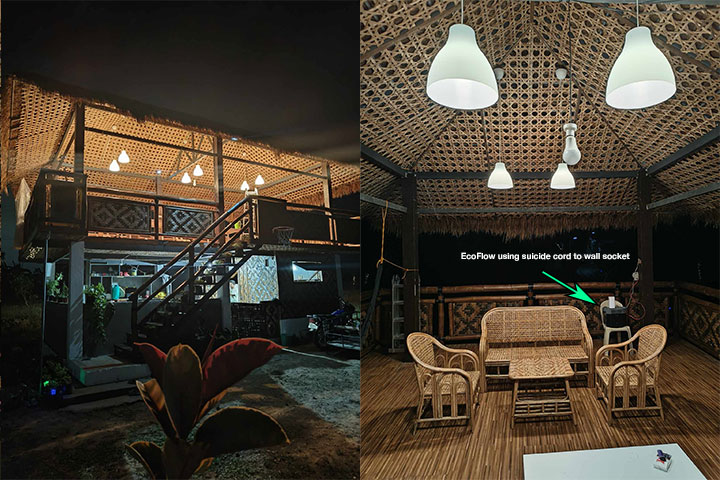
So, while waiting for a final decision to either install an off-grid solar system or re-apply for power from the local co-op (and do the expensive re-wiring again), we already prepared the farm by slowly wiring the lights, sockets, switches and breakers across 5 or so structures.
We simply charged our EcoFlow with a neighbor in a nearby village and then bring up the unit to the farm before nighttime. We directly plugged the EcoFlow into the AC socket on the main building (using a suicide cord) and the entire property is now powered by the EcoFlow. Since the entire electrical network is off-grid, the setup is relatively safe and actually worked flawlessly.
The other good thing about this setup is that we’re able to re-charge the unit using the portable solar panel while the EcoFlow is hooked up to the network. It’s like having an off-grid solar system with a back-up battery, but in our case, everything is managed by the EcoFlow power station.
This was the most useful case-use of the EcoFlow power station and something that really convinced us of how important this device has become in our daily lives.
High-Power Ad-Hoc Setup
We also discovered this possibility only recently during the re-building of our farm structures. Even after we finally had grid power on the farm, many parts of the property remain unconnected to the grid power due to their distance from the local outlet, and the use of an extension cord is not feasible or expensive, we turned to the EcoFlow for a portable high-power source.
We used an inverter welding machine to put up the metal gates to the cement post with only the EcoFlow as the source. We also used an angle grinder to cut off the old metal posts for the electric wire and re-purpose them as solar lamp posts within the property.
Verdict
Over the years, we’ve seen the growing importance of a portable power station and EcoFlow has managed to create new and more powerful models that can cater to both casual users and high-power users.

Without a doubt, and despite its slightly hefty weight and price point, the EcoFlow DELTA 2 Max is high-performance, feature-rich portable power station especially suited for demanding users.
Its combination of fast charging, high output, long battery life, and smart app integration makes it a top choice for off-grid adventures, emergency preparedness, and home backup.
While not the lightest or cheapest option in the EcoFlow line-up, its reliability and expandability make it worth the investment for those who need dependable, versatile power in almost any imaginable situation.
The DELTA 2 Max retails for Php64,590 (click here) while the DELTA 2 Max and NextGen 220W Portable Solar Panel combo sells for PHP 80,880 (from PHP129,280) for the bundle. You can get this from the official EcoFlow website (see here).
(Note: Use EFPHAFF5 as voucher coupon to get additional 5% off on check out on the EcoFlow website.)
If you already have an EcoFlow, you can add the 220W Bi-facial Portable Solar Panel over at Lazada (click here) for Php 18,290.







0 Comments
Leave a Reply