
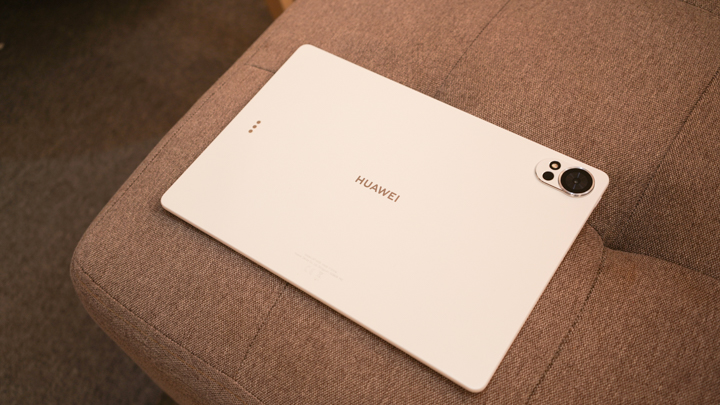
HUAWEI MatePad 12 X (2026) Review



Huawei has introduced some impressive audio solutions, but the HUAWEI FreeArc takes things to a whole new direction.
Open-ear audio is becoming the go-to for users who want great sound without complete isolation. Basically, people who wanna hear their media playback privately, and also want to hear their surroundings at the same time.

Over the years we’ve seen visor-looking bone-conduction headphones, and even plug-in open back ones! But with the HUAWEI FreeArc the brand once again aims to bring their own spin to open-ear technology.
Let’s check it out in this review.

One of the biggest selling points of the FreeArc is its design.
Unlike traditional earbuds that seal into your ear canal or bulky over or on-ear headphones, the FreeArc features well.. An Arc!
–Or a lightweight open-ear structure that hooks around the lobes of our ears.
At just 9 grams, it’s one of the lightest open-ear options available, making it comfortable for all-day wear. The frame feels sturdy yet flexible, ensuring a secure fit even during movement.

The clam-shell case on the other hand, is on the bigger side compared to more traditional wireless earbud cases, which may or may not be an issue depending on the size of our pockets.
The case dimensions aren’t anything out of the ordinary for those used to dishing out their own powder cases, and in hindsight, the FreeArcs aren’t as fatiguing as normal in-ear buds in general-use.

It’s available in three colorways: Green, Black, and Gray. And it sports an IP57 rating for protection against dust-sized particles and freshwater-submersion of up to 1m for under 30 minutes.
–Which is why we’re sure, the HUAWEI FreeArc’s themselves are rain and workout safe!

For the actual listening experience, feedback is a little mixed here in the Yugatech HQ.
Huawei’s Open Acoustic Technology ensures that even though it doesn’t go inside our ears, we still get an immersive sound experience.
Unlike bone conduction headphones, the FreeArcs utilize Directional Audio Projection, which directs sound waves toward our ears without disturbing those around us with audio leakage.
–It’s pretty much wizardry!

But like I mentioned, the reception here in the office is a little mixed.
The fit of the FreeArcs are actually pretty amazing for what they are, there’s no doubt about it. But in our opinion, they fit average to larger sized ears the best.
Those with smaller lobes like myself can find the fit a little challenging and a lot easier to shake-off.
And sometimes at particular angles, we could actually feel the sound waves projected across our ears to a point where it can feel a little overwhelming, compelling me to put them away before I get a migraine.
–Once again, all of that insight comes from the way the FreeArc’s fit on smaller ears. If you’re someone with average to large-sized ears, this shouldn’t be an issue.

With that said, the HUAWEI FreeArc’s deliver a nice balanced sound profile, with surprisingly good enough bass, clear mids, and crisp highs that can actually get quite loud at higher volumes.
–Which surprised almost every first-time tester in the studio.

The reason they sound as good as they do, is thanks to what HUAWEI calls their Sterling Sound technology. Which is made up of the 17x12mm titanium-plated diaphragm audio drivers found in each FreeArc.
Which is also what makes it smart enough to adjust the volume automatically based on ambient noise, ensuring optimal listening levels at all times. But if that was information-overload, let’s just stick to calling it wizardry!

The FreeArcs also feature Mutli-Device connection, which means we could be paired to an Android and iPhone at the same time, or even a phone and a computer at the same time.
Which is perfect for switching between different media playback sources and answering calls across all our devices.
A notable thing we did notice is how playback volume can be a little finicky when too many devices are connected;
This one time, out at night in a crowded restaurant, while connected to both an Android and iPhone. We noticed that max volume from the FreeArc when playing back music from the iPhone was noticeably softer compared to doing the same thing on the Android phone.

To be fair, this might’ve been user error, since we haven’t been able to recreate the issue, possibly also thanks to a software update within the companion HUAWEI Ai Life app.
Speaking of companion apps, in Ai Life users get the ability to connect and disconnect from various paired devices, adjust sound EQs, and map gesture control to name most.

And like most HUAWEI smart products, Battery Life is on-point!
The FreeArc’s are rated for 7 hours of continuous music playback on a full charge, and 28 hours with quick recharges from the fully charged case. Those numbers drop down to 5 hours on a full charge and 20 hours with the case, when used mainly for voice calls.

With the case, charging the FreeArcs from empty takes about half an hour. And charging the case itself from empty takes an hour.
For the 2-3 weeks we’ve been testing them, we’ve only really had to charge the case once.
So like we said, battery life is non-issue like usual.

So, with everything we’ve covered, let’s answer the question: For whom is the HUAWEI FreeArc made?
Well in our opinion, they’re designed for users who want an immersive yet natural audio listening experience.
It’s perfect for commuters and even outdoor joggers and runners that want to stay aware of their surroundings while still enjoying music, a podcast, or taking calls.

But some of you may even argue that more traditional earbuds get audio pass-through anyways, well yes, that may be true but that pass-through audio comes from a microphone situated on the exterior of the buds, which can sound muffled with contact, and possibly covered by debris or any other similar outside forces.
Some may even have a delay, which is definitely a big no-no for those road runners in traffic and alike.

And finally, it’s also made for Tech-Savvy Users looking for a futuristic and innovative audio solution.
Stay away from buying or gifting this product if you know the person it’s intended for has a smaller than average ear size!
In conclusion, the HUAWEI FreeArc proves that open-ear audio can be both stylish, comfortable, and premium-sounding.
And overall, they’re a solid contender in the open-ear audio space offering premium quality and smart features in a sleek package.
If you’re looking for an alternative to traditional earbuds that keeps you connected to your environment while delivering great sound, this might just be the best option out there.
These definitely give you that main-character movie soundtrack background music vibes you’ve never known you wanted.
The HUAWEI FreeArc will be available for purchase in the Philippines from HUAWEI physical stores and official online channels by April 29, 2025.
What we LIKED:
What we Liked LESS:
HUAWEI FreeArc specs:
17mm × 12mm highly-sensitive driver unit
Bluetooth 5.2
Pop-Up Pair support (EMUI 10 and up)
Hall sensor
CAP sensor
Swipe, double-tap, triple-tap, press & hold controls
55mAh battery (per earbud)
510mAh battery (charging case)
USB Type-C (5V2A)
IP57 rating for dust and water resistance (earbuds)
45.4 x 18.35 x 47.50 mm (earbud dimensions)
8.9 grams (earbud weight)
67.80 x 67.80 x 26.50 mm (charging case dimensions)
67 grams (charging case weight)
Green, Black, Grey (colors)






Apple, Asus, Cherry Mobile, Huawei, LG, Nokia, Oppo, Samsung, Sony, Vivo, Xiaomi, Lenovo, Infinix Mobile, Pocophone, Honor, iPhone, OnePlus, Tecno, Realme, HTC, Gionee, Kata, IQ00, Redmi, Razer, CloudFone, Motorola, Panasonic, TCL, Wiko
Best Android smartphones between PHP 20,000 - 25,000
Smartphones under PHP 10,000 in the Philippines
Smartphones under PHP 12K Philippines
Best smartphones for kids under PHP 7,000
Smartphones under PHP 15,000 in the Philippines
Best Android smartphones between PHP 15,000 - 20,000
Smartphones under PHP 20,000 in the Philippines
Most affordable 5G phones in the Philippines under PHP 20K
5G smartphones in the Philippines under PHP 16K


