
HUAWEI MatePad 12 X (2026) Review



Shortly after its global unveiling, the new Nothing Phone (3) has made its way to the Philippines. It is the brand’s very first “flagship” phone release, and it certainly got the whole tech community talking.
I have watched the global launch myself, and oh boy– the comments on that livestream were flooded with either a big “W” (win) or straight up “L” (loss), and obviously, you can kinda see why.

But let’s set aside any of your impressions for now because beyond the looks, how is the performance? How good are the cameras? What about battery life? We’re going to answer all that in this full review.
First, let’s talk about the looks.
While Nothing is known for its quirky designs, like integrating a mix of both industrial and transparent look into pretty much all of their devices, what they did with the Phone (3) is quite intriguing.
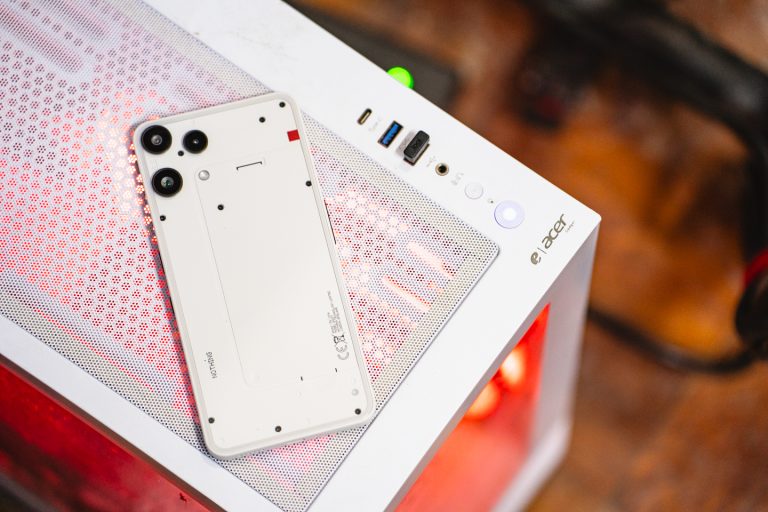
For the most part, it still carries Nothing’s DNA with that transparent back panel and geometrical patterns splashed all over. However, you would notice a major design change here and that is the absence of the iconic Glyph Interface.

Those strips of LED lights at the rear from previous Nothing phones? They’re now gone, and replaced by the so-called Glyph Matrix.
It is essentially a secondary screen that you can find on the top right corner of the back panel. Although, as you can see, this screen is housed in a circular panel and features a dot-matrix array to display graphics and images. Specifically, there are 489 tiny LEDs housed in there.
When you think about it, the Glyph Matrix is actually thematic to Nothing’s design language, and that’s cool.

Interestingly, it gets accompanied with a capacitive button just a couple of inches below it. A single tap lets you cycle through the “Glyph Toys” and a long press lets you interact with it.
You can actually play ‘spin the bottle’ on this thing! Or you can use it as a sort of a viewfinder, so that you can use the rear cameras to take selfies. (Taking wide-angle selfies should be a piece of cake.)
It’s fun, definitely, especially for someone like me who naturally leaves my phone facing down on the table. However, there isn’t much real utility that you can get out of this, aside from the custom notification icons or the viewfinder, I guess? But beyond those, it’s basically just an aesthetic flair telling you that this phone is a Nothing phone. Period.
But enough of the Glyph Matrix, let’s talk about the elephant in the room: the design.
Taking a good look at the Nothing Phone (3)’s design, I’ve got mixed feelings with it. As much as I want to appreciate the aesthetics and all, that asymmetrical camera layout bugs me out.

It’s not bad per se. It’s just a very interesting design choice. Everything else aside from that, though, the phone looks nice and well-crafted, I’ll give it that.
The online renders or even the product shots you’ve seen here don’t quite do it justice. But in person, it still surprisingly looks good and feels premium in the hand.
Perhaps my key takeaway from this is that Nothing isn’t really going for comfortable aesthetics, you know what I mean? As a brand, they’re always going to break the norm in hopes of “making tech fun again,” and I’m pretty cool with that.
Honestly, I think this whole debate surrounding the Phone (3)’s polarizing design is a win for Nothing. It sparks discussions everywhere—some hate the asymmetrical camera layout, some prefer the LED party lights from before, while others actually dig the new look. At the end of the day, Nothing is gaining all the traction, so the more we talk about it, the more free PR they get.

Moving on to build quality, it-gets flagship grade materials: layers of Corning Gorilla Glass placed on both front and back panels, and a smudge-resistant, flat aluminum frame. The phone is also IP68-rated for dust and water resistance.
For I/Os, just like the previous iterations, you’ll find the power button on the right, accompanied with the Essential Key. The volume rocker is on the left, while the USB-C port is on the bottom along with a speaker grill, a microphone slit, and the SIM tray. Up top, there’s the second speaker grill and another microphone.


And by the way, the little red square on the back actually lights up and blinks when you’re recording a video.
Flip the phone over, you’re greeted by a 6.67-inch flexible AMOLED display running at a smooth 120Hz refresh rate. Peak brightness maxes out at 4500 nits, and it gets Gorilla Glass 7i on top. Mind you, this glass is mostly used in mid-range devices and the main difference is that it’s not quite on par with the likes of the Gorilla Victus line that is used on more expensive flagships.

Weirdly enough, the Nothing Phone (3) is marketed as a flagship phone, yet there is no LTPO here. The average user may not notice it, unless they look at the spec sheet, but it just means it misses out on some power efficiency that LTPO panels offer.
Despite that, the Phone (3) provides stunning visuals with sharp detail, vivid colors, and good contrast with deep, true blacks. It has even bezels all around, although, it’s not as thin for some reason that it almost looked like a Galaxy A56.

Still, I’ll take the even bezels any day for that matter.
For audio, it features dual stereo speakers that output a nice sound stage with clear highs and mids, and seemingly decent, punchy bass.

Security-wise, the phone gets an under-display fingerprint sensor, though it’s an optical one rather than an ultrasonic sensor. But yeah, the unlocking experience is still fast in my opinion.
Now onto camera performance. As the first flagship, I have high expectations for the Nothing Phone (3).
At the rear, it features a trio of 50-megapixel sensors for a primary camera with OIS, an ultrawide, and a periscope telephoto lens, also with OIS. While up front is yet another 50-megapixel sensor for selfies.

As far as the image quality is concerned, the Nothing Phone (3) did not disappoint. Images coming out from this device offer flagship-level quality with sharp detail, good color reproduction, and good amount of dynamic range.\
Ultrawide shots are nice, too. However, the periscope telephoto with 3x optical zoom makes the colors a bit unnatural with softer detail even in bright environments.
One thing I noticed though, is that most of the shots are brighter than usual and the phone tends to wash out the blacks so often. But if ever that happens, a simple exposure adjustment will do.
As for video capture, the Phone (3) also does a great job. Details are sharp, though colors tend to be warmer at times. It doesn’t quite match the new iPhones in terms of quality, but it’s good enough for your casual snaps, especially with the amount of flexibility this phone offers.
Moving on to performance, this is where things go a little bit questionable.
Inside the Nothing Phone (3) is the Snapdragon 8s Gen 4 (4nm). Sure, it’s the latest one from Qualcomm, and yes, it’s technically a “flagship-level” chipset.
But it’s hard not to ask: why is it not using the cutting-edge Snapdragon 8 Elite (3nm) instead? To make matters worse, the POCO F7 exists using the same Snapdragon 8s Gen 4, and yet it’s priced at nearly half the cost of the Nothing Phone (3).

I must say, it’s not just about the chipset used. I understand that there are other factors at play, like R&D, hardware, and so on, that influence the final price. But for a first Nothing flagship, I would’ve preferred it to have the latest and greatest chipset available. But that’s just me.
Setting that thought aside, the average user will barely see any difference. The Snapdragon 8s Gen 4, in its own right, is a pretty capable chipset overall. In fact, our benchmark results back that up, achieving high scores across the board.
| Benchmark | Nothing Phone (3) |
|---|---|
| Chipset | Snapdragon 8s Gen 4 |
| AnTuTu V10 | 1,962,026 |
| AnTuTu Storage | 238,590 |
| S.Read Speed | 4004.7 MB/s |
| S.Write Speed | 3791.7 MB/s |
| 3DMark Wild Life | MAXED OUT |
| 3DMark Wild Life Extreme | 4,121 |
| Geekbench 6 CPU Single-Core | 2,143 |
| Geekbench 6 CPU Multi-Core | 6,741 |
| Geekbench 6 GPU OpenCL | 13,612 |
| Geekbench 6 GPU Vulkan | 18,687 |
| PCMark Work 3.0 performance | 14,772 |
| PCMark Work 3.0 battery life | 17 hrs & 49 mins |
With that in mind, the phone handles everyday tasks with ease. Navigation feels smooth, and it can easily run all your casual games while performing surprisingly well with more graphically demanding titles.
Playing with Maxed-out graphics is definitely possible, although I prefer keeping it on Medium settings to avoid overworking the chip and to save on some power consumption.
It does heat up after prolonged use, but it’s usually not alarmingly hot, mainly thanks to a fairly lightweight and optimized software, which we’ll talk about next.
The Nothing Phone (3) runs on the NothingOS 3.5 based on Android 15 out of the box. As you’d expect out of a Nothing device, the UI looks nice and clean, free of any bloatware, except the first-party apps, of course.

It almost feels like Stock Android, but with a little bit of Nothing flair like those dot matrix text and graphics on the widgets, the monochrome icons, and of course the addition of the Essential Space.


As someone who tends to take note of every possible thing I come up with, I appreciate this feature, especially with a handy button on the side, which is the Essential Key.

This app is basically a supercharged notes app that curates your images, screenshots, reminders, and even voice notes in a more user-friendly way—essentially, a thought organizer of sorts, powered by AI.

Going back to the Glyph Matrix, there’s also a dedicated settings menu where you can create custom notifications. This is also where you’ll find the Glyph Toys for a quick overview.

Perhaps, one of the best things about the Nothing Phone (3) is it’s promised to get five years of major OS upgrades and seven years of security patches. That’s a step up from previous Nothing phones that have shorter update windows.
Another strength of the Phone (3) lies in its battery life. While the phone gets a slightly larger 5150mAh unit, it can easily last you an entire day of use—perhaps thanks to a more optimized software.

In our PCMark battery life test, the phone surpassed 17 hours and 49 minutes of runtime, which is absolutely a solid result.

As for charging, the Phone (3) supports 65W of wired and 15W of wireless charging. These aren’t the fastest charging tech in the market, but they will do just fine. Sadly, no bypass charging here, so keep that in mind.

Connectivity-wise, the phone features dual nano-SIM alongside eSIM support, 5G, NFC, Wi-Fi 7, and Bluetooth 6.0.
Now, we’ve come to the last part of this review, the price.
The Nothing Phone (3) starts at PHP 44,999 for the 12GB+256GB config, while the larger 512GB version goes for PHP 50,999.

At that price, it sounds like a flagship for sure. While there are some clear cutbacks like having no LTPO OLED display or not opting to use a true flagship chip such as the Snapdragon 8 Elite, those who will get the Nothing Phone (3) are surely in for a suitable flagship experience, at the very least.

After all, it still has a nice screen, superb cameras, a sleek and clean software experience with longer updates, solid battery life, and arguably, a unique and functional aesthetic. These key aspects all work together to deliver one of the better, if not the best, flagship experiences available at a significantly lower cost as compared to the big guns like Apple or Samsung.
What we liked:
What we didn’t like:
Nothing Phone (3) specs:
6.67-inch FHD+ flexible AMOLED
1260 x 2800 pixels, 120Hz refresh rate, 460 ppi
1600 nits (outdoor), 4500 nits peak brightness
Corning Gorilla Glass 7i
Qualcomm Snapdragon 8s Gen 4 (4nm)
Octa-core, up to 3.21GHz
12GB, 16GB RAM
16GB+512GB storage
Triple rear cameras:
– 50MP f/1.68 main, OIS
– 50MP f/2.68 periscope tele, OIS
– 50MP f/2.2 ultrawide
50MP f/2.2 selfie shooter (punch hole notch)
Dual nano-SIM, supports eSIM
5G, 4G LTE
Wi-Fi 7
Bluetooth 6.0
GPS, GLONASS, BDS, GALILEO, QZSS, NavIC, SBAS
USB Type-C
NFC
Under-display fingerprint sensor (optical), face unlock
IP68 dust and water resistance
Dual stereo speakers
Nothing OS 3.5 (Android 15)
5 years OS upgrades, 7 years security patches
5150mAh battery
65W charging (wired)
15W wireless, 7.5W reverse wired charging
160.60 x 75.59 x 8.99 mm
218g
White, Black (colorways)






Apple, Asus, Cherry Mobile, Huawei, LG, Nokia, Oppo, Samsung, Sony, Vivo, Xiaomi, Lenovo, Infinix Mobile, Pocophone, Honor, iPhone, OnePlus, Tecno, Realme, HTC, Gionee, Kata, IQ00, Redmi, Razer, CloudFone, Motorola, Panasonic, TCL, Wiko
Best Android smartphones between PHP 20,000 - 25,000
Smartphones under PHP 10,000 in the Philippines
Smartphones under PHP 12K Philippines
Best smartphones for kids under PHP 7,000
Smartphones under PHP 15,000 in the Philippines
Best Android smartphones between PHP 15,000 - 20,000
Smartphones under PHP 20,000 in the Philippines
Most affordable 5G phones in the Philippines under PHP 20K
5G smartphones in the Philippines under PHP 16K


