
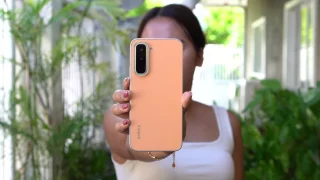
Meet the OPPO Find X9, the brand’s latest flagship that has arrived in the Philippines. We managed to secure ourselves a review unit, and it did not disappoint.

Backing it is the new MediaTek Dimensity 9500 chipset, ColorOS 16 update, and Hasselblad-tuned cameras. This also marks the second time that a device from OPPO’s Find X line has launched here in the country.
I’m sure we’re all curious to see how the Find X9 fares, so let’s dive right in!
Design and Construction
The Find X9 kept its ergonomically compact size from last year’s model. It feels slim, measuring at 7.99mm, and weighs around 203 grams.
It has a flat-edge design that feels sleek and makes it easy to carry or slide into pockets. In terms of materials, it has an aluminum frame and matte glass back panel.

That said, it feels sturdy and premium, sporting an impressive build just like its predecessor. However, I must say, I’m not a fan of the camera module redesign.
For reference, last year’s model had a watchface-like camera module with Hasselblad branding centered and the LED flash placed outside. Now, we have a slightly protruding square-shaped module reminiscent of OPPO’s Reno smartphone line.

Users can find three cameras in the enclosure and the LED flash within. Notably, the flash is branded with the Hasselblad logo, albeit more lowkey this time around.

At the front, we have the display panel, which is protected by Gorilla Glass 7i. The screen comes with really thin bezels, which I’m sure most users will appreciate.

For buttons and ports, we have the volume rocker and power button on the right side.

On the left, we have the Snap Key, which is essentially a customizable action button (similar to the iPhone’s Action button, if you will).

Some of the functions you can set it to include Mind Space, DND, a camera shortcut… you get the idea.

At the bottom, you’ll find a USB Type-C port, what we assume is two microphones, and one of two speakers.

There’s also an IR blaster on top, with the earpiece doubling as the second loudspeaker.


Lastly, this phone boasts a triple ingress protection rating: IP66, IP68, and IP69. This means users have extra peace of mind should they drop the phone underwater or get splashed by water jets.
All things considered, the Find X9 retains its nice impressions from its predecessor. It feels premium, sturdy, and now, a bit more muted.
Not sure if they were going for this, but it makes OPPO’s offerings feel more uniform than ever. Of course, changes were mainly its camera island redesign, Snap Key addition, and improved IP rating.
Display, Multimedia, and Biometrics
Going back to the screen, the Find X9 has a 6.59-inch ProXDR OLED display. It supports up to 1.5K resolution and a refresh rate of 120Hz. The panel also features Dolby Vision, HDR10+, and a lowered 3600 nits of peak brightness (as compared to 4500 nits on the Find X8).

Sadly, it’s not using an LTPO panel, so that’s bit of a bummer.
Despite the fact, users can find that it offers rich colors and true deep blacks. Scrolling feels fluid as well, which ties in with how the new ColorOS 16 makes the general experience smoother than usual.

Mostly, I used the phone to binge watch Jujutsu Kaisen before the next season drops. I also watched this movie called “Parachute,” which made it feel all the more cinematic. I would definitely recommend binging videos on this device, 10 out of 10.
Audio-wise, the phone has good clarity, bass, and vocal separation. However, it does lack in loudness, which is the same issue it had last year.

That said, it has nods in lows and mids, but the highs for the sound stage leave a little more desired. Generally though, I’m sure users won’t really be able to tell as they sound good either way.

Onto biometrics, the X9 offers an in-display ultrasonic fingerprint sensor and facial recognition. Enrolment is hassle-free and won’t last more than two minutes, and both features also work fairly quick without any gripes on our end.
Cameras
For optics, the OPPO Find X9 offers a well-rounded experience with its Hasselblad-tuned imaging system. This includes three 50-megapixel rear cameras along with a 2-megapixel monochrome lens. Up front, there’s a 32-megapixel selfie shooter.

The main camera and the telephoto feature optical image stabilization (OIS). Collectively, the rear cameras are capable of recording videos up to 4K at 120 fps while the front camera’s capped at 4K at 60 fps.
Given its predecessor’s performance under this department, expectations were high. After a good afternoon with the phone, it certainly did not disappoint.
OPPO Find X9 Main, Telephoto, and Front Samples
Monday, Oct 27, 2025


Subject separation is great, the colors pop out, and images come out with a natural look with or without HDR. It’s not too shabby under low lighting conditions either, as it’s able to produce photos equal to what your eyes would see.
Granted, we figured it leverages post-processing to its advantage. However, the results are more than satisfactory.

Like last year’s model, the camera comes with a macro mode which did pretty well despite my shaky hands. Meanwhile, its ultra wide lens has the same issue as it did last year.
Sample macro shots:
OPPO Find X9 Macro Samples
Monday, Oct 27, 2025

If a user would care to zoom into a taken photo, it’s not as sharp as you’d expect. Of course, if you aren’t too nitpicky, then you wouldn’t be able to tell anyway.
Sample ultrawide shots:
OPPO Find X9 Ultra Wide Samples
Monday, Oct 27, 2025
Video recording, on the other hand, felt pretty smooth under good lighting. The autofocus latches on to the subject pretty fast.

If you’re into taking night shots, expect quality to dip and grain to come in. Either way, it’s still fairly decent.
Here are a couple of sample videos for you to have a better idea.
For shooting modes, there’s also Master mode or OPPO’s version of Pro mode and Hasselblad Hi-Res that stand out apart from the usual suspects. This includes night mode, panorama, et cetera.

To sum up this segment, users can expect generally great photos across the main and telephoto shooters. While the ultrawide lens is great, it could definitely use some work if you’re the type to zoom in for details.
Performance and Benchmarks
Under the hood, the Find X9 is powered by a MediaTek Dimensity 9500 SoC with our review unit having 16GB of RAM and 512GB of storage. This 3-nanometer chipset has clock speeds of up to 4.21GHz, which is a noteworthy leap from its predecessor (which used Dimensity 9400, clocked at up to 3.63GHz).

There’s also other components at play, such as its ARM G1-Ultra GPU, the OPPO Trinity Engine, and the MediaTek NPU 990. We had heating issues with its predecessor, but now it’s been remedied.
OPPO says the GPU not only has better performance, but also a customized cooling system. After an hour into Genshin Impact, I felt some warmth, but it wasn’t an alarming amount of heat from the device.

We were able to run the game with the highest graphic settings, and it was smooth throughout our short gameplay. This was our tell that the chipset is more than capable of running intensive tasks smoothly.
Meanwhile, their Trinity Engine helps with optimizing power usage for different tasks. I’d love to talk about power consumption, but we’ll get into that a bit later.
For those of you interested in the numbers, check-out our benchmark scores right here.
| Benchmark | OPPO Find X9 |
| Chipset | MediaTek Dimensity 9500 |
| AnTuTu V11 | 2,262,204 |
| AnTuTu V11 (HIgh-perfomance mode) | 2,381,206 |
| AnTuTu Storage | 152,655 |
| S.Read Speed | 4000.0 MB/s |
| S.Write Speed | 3680.5 MB/s |
| 3DMark Wild Life | MAXED OUT | Avg. FPS: MAXED OUT |
| 3DMark Wild Life Extreme | 6,853 | Avg. FPS: 41.04 |
| Geekbench 6 CPU Single-Core | 3,234 |
| Geekbench 6 CPU Multi-Core | 9,457 |
| Geekbench 6 GPU OpenCL | 22,916 |
| Geekbench 6 GPU Vulkan | 28,163 |
| PCMark Work 3.0 performance | 13,035 |
| PCMark Work 3.0 battery life | 22 hrs & 8 mins |


OS, UI, and Apps
For software, the Find X9 comes with Android 16 out of the box with the highly-anticipated ColorOS 16 skin on top. Generally, the software is responsive, smooth, and fluid.

At first glance, we can see that OPPO surely took some design cues from Apple’s iOS. They even have their own take of the Dynamic Island, which looks much better in my humble opinion.


There’s also the addition of Mind Space, which we felt like was derived from Nothing’s Essential Space.
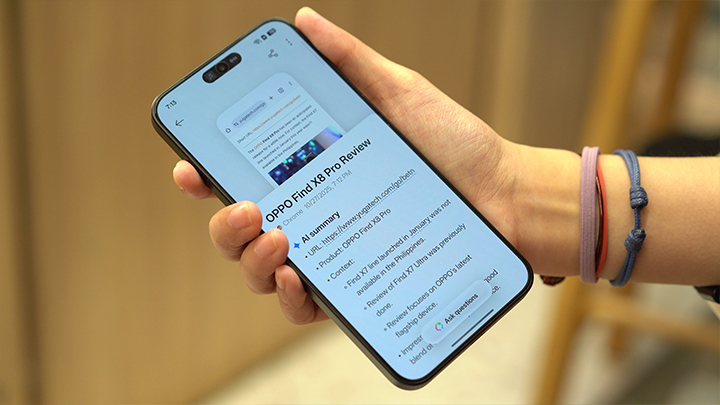

Basically, this productivity feature leverages AI to take note of information on your phone via screenshots or voice notes which primarily makes summaries or analyses in a user-friendly manner.

In case some readers are curious, this device comes with barely any bloatware. Pre-installed first- and third-party apps are there, but they’re usually very useful. These include Facebook, Instagram, Netflix, Spotify, and Zen Space. The phone also has Google Gemini with Circle to Search in case you need to look something up with ease.
Unfortunately, we don’t have the info about its software update policy yet at the time of writing. However, we will provide an update when details are available along with separate in-depth video about ColorOS 16.
Connectivity and Battery Life
Battery-wise, the OPPO Find X9 packs a massive 7,025mAh unit, which is nuts considering how thin the phone is.

It also supports up to 80W of wired charging, 50W of wireless charging, and 10W of reverse wireless charging.

On a daily basis, I’ve been using it for browsing, streaming, some light gaming, and taking snaps. From experience, my usage barely made a dent in power consumption. I’m happy to report that this is the same case as per our benchmark tests.
In PCMark Work 3.0 battery life test, the Find X9 had 22 hours and 8 minutes of uptime, which is definitely a solid result. This was taken on airplane mode, volume muted, with brightness set to 50%.
Meanwhile, in our proprietary video loop test, the phone was able to offer 26 hours and 11 minutes of playback. This test was done by playing a full HD movie with the same factors present in the previous test.
We’d say this is an impressive score that’s credited to the OPPO Trinity Engine. It seems as if it really did put in some work to manage power consumption.

Moving on, connectivity options include the essentials: 5G, dual nano-SIM slots with eSIM support, Wi-Fi 7, Bluetooth 6, NFC, and an IR blaster for easy universal remote control with your home appliances. Call and mobile data quality on both mobile or Wi-Fi did pretty well with no issues on our end.
Verdict
All things considered, we believe that the OPPO Find X9 is sick! It’s pretty favorable across the board with the only cons so far being its camera module redesign and lacking a loud sound stage.

Now then, both of these things can be subjective and will boil down to user preference. What doesn’t lie is numbers, and the Find X9 proved to deliver a satisfying experience thanks to its fresh software skin and a powerful chipset, combined with a long battery life.
You could argue that improvements to its display and cameras were incremental, but they didn’t do that bad last year. That said, I’d understand if OPPO didn’t want to change these as much. How does the saying go? If it ain’t broke, then don’t fix it.

However, the Find X9’s pricing is pretty steep. The OPPO Find X9 is priced at PHP 69,999 in a single configuration with 16GB of RAM and 512GB of storage. It’s currently available for pre-orders in the Philippines with some added freebies.
Notably, the pre-order perks include a free DJI Osmo Mobile SE gimbal and a discount voucher worth PHP 2,000. If the hefty price tag isn’t a bother for OPPO native users looking to upgrade, then this phone isn’t bad by all means.
But, what do you guys think? Let us know in the comment section below.
What we liked:
- Fluid display and OS integration
- Build quality
- Great cameras
- Long-lasting battery life
What we didn’t like:
- Camera module redesign
- Lack of loudness in audio
- Price
OPPO Find X9 specs:
6.59-inch 1.5K (2760 x 1256) ProXDR OLED display (~460 ppi)
120Hz refresh rate, 3,600 nits (peak)
Dolby Vision, HDR10+, HDR Vivid
Corning Gorilla Glass 7i protection
MediaTek Dimensity 9500 (3nm, up to 4.21GHz)
ARM G1-Ultra GPU
OPPO Trinity Engine
MediaTek NPU 990
16GB LPDDR5X RAM
512GB UFS 4.1 storage
50MP main camera (f/1.67, OIS, 23mm, 1/1.4-inch sensor)
50MP periscope telephoto (f/2.6, 3x, OIS, 73mm 1/1.95-inch sensor)
50MP ultra wide (f/2.0, 15mm, 1/2.76-inch sensor)
Hasselblad color calibration, color spectrum sensor
LED flash
Up to 4K at 120 fps video recording
Gyro-EIS, HDR, 10-bit video, LOG
32MP front camera (f/2.4, 21mm)
Up to 4K at 60 fps video recording
Stereo speakers
5G. 4G LTE
Dual nano-SIM (eSIM supported)
Wi-Fi 7 (dual-band)
Bluetooth 6
GPS
NFC
IR blaster
OTG
USB Type-C
ColorOS 16 (Android 16)
Fingerprint sensor (in-display, ultrasonic)
Face unlock
7,025mAh battery
80W fast charging support (wired)
50W wireless charging, 10W reverse wireless charging
IP66/IP68/IP69 rating (dust and water resistance)
156.98 x 73.93 x 7.99mm (dimensions)
203 grams (weight)
Titanium Gray, Space Black (colors)

0 Comments
Leave a Reply