

Earlier this year when I reviewed the POCO F7 Pro, I wrapped it up with the sentiment that bigger brands like Samsung really need to start stepping up because the value consumers can get from something like POCO’s F-series can really start to make us think twice on whether we truly need a flagship device or not.
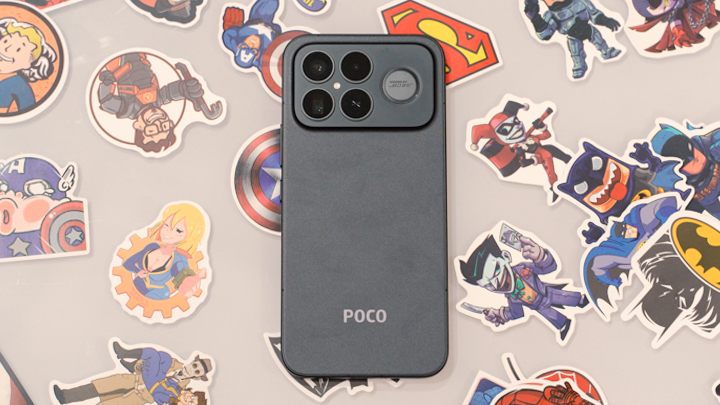
Now in Q4 of the same year, POCO is back. This time I got my hands on the POCO F8 Ultra, and this time it really feels like they aren’t playing around.
Packed with a cutting-edge Snapdragon processor, a massive battery, ultra-fast charging, and a triple 50MP camera system, the F8 Ultra aims to deliver true flagship performance without the flagship price.
So without further ado let’s get into it.
Design and Construction

The POCO F8 Ultra looks and feels like a premium flagship from the moment you pick it up without a case.
It features a bold camera island (or should I say plateau? –whatever POCO did it first) with a unique integrated IR (infrared) sensor found in the lower right camera ring, which in usual Xiaomi/POCO fashion allows us to use the handset as a remote for controlling appliances.
The glass back panel gets a satin finish with POCO branded on the lower center. I’m sure most of you have also noticed the Bose-branded mini subwoofer on the camera island as well, more on that later.

The aluminum frame feels sturdy with good ergonomics for button placements, which are all located on the phone’s right side.
This handset falls into plus-sized territory with practically the same dimensions as the Xiaomi 17 Pro Max and iPhone 17 Pro Max. And despite the large battery it’s a well-weighted device at 218 g for comfortable day-to-day use. There’s a Denim Blue variant that’s a little heavier too.

Found up top is one-half of the stereo speaker drivers. Its pair can be found at the bottom alongside the USB Type-C port, primary mic, and dual nanoSIM card tray. The phone also get IP68 certification for dust and water resistance, which also means it is rated for submersion of up to 1.5 meter for 30 minutes.

Overall for build and design, we like it! Sure it may be a rebranded Redmi K90 Pro Max, but honestly they probably aren’t officially supporting that model here anyways. Either way, the construction feels very plus-sized flagship level and we’re all for it.
Display, Multimedia, and Biometrics

Front and center is the 6.9-inch 2K (2608 x 1200) LTPS AMOLED display with a 60 to 120Hz adaptive refresh rate, and POCO Shield Glass for protection.
It’s sharp, vibrant, and incredibly bright with a peak brightness that goes up to 3,500 nits perfect for outdoor use and mixed media consumption. If there’s anything to complain about, it’s the fact that it’s a little too bright for late night binges.
So much so, we wished there was something like an “Extra Dim mode” in Display or Accessibility settings (Which used to be in MiUI.)
The panel is Widevine L1 certified with support for HDR10+ and Dolby Vision.

Despite personally not being a fan of plus-sized handsets, the 19.5:9 aspect ratio we get from the F8 Ultra is pretty sweet for watching shows and movies with varying widescreen formats, even without filling out the whole display.
Color reproduction is great with its wide DCI-P3 color gamut support. And with a touch sampling rate of up to 2560Hz, navigating through the more optimized interface and playing games feel snappy.
The multimedia experience double-downs on immersion with the impressive 2.1 channel Bose stereo speaker system, including the aforementioned dedicated micro-subwoofer that delivers actual lows from a smartphone speaker.

With additional support for Dolby Atmos, the sound-stage has a lot of presence even at lower volumes, but depending on the music end-users listen to, the lows can sometimes drown out the mids and highs especially in higher volumes.

In my opinion, it has “I have a BT speaker for a phone” qualities and it deserves all the praise for having actual bass presence coming out of a smartphone. It may not be the best audio system in a phone ever, but it’s definitely in the top 5 for this year.
Overall it’s a 9/10 experience for us in terms of multimedia consumption on the POCO F8 Ultra.

Biometrics include an ultrasonic in-display fingerprint scanner that recognizes our prints very fast and accurately, even when our fingers are a little damp. There’s also optical face unlock if you’re into that, but the in-display scanner should be more secure in our opinion.
Cameras

For cameras, POCO equips the F8 Ultra with a triple 50MP rear camera system. That’s a 50MP main, 50MP periscope telephoto that serves as the 5X optical zoom, and a 50MP ultrawide with a 102° field of view.
The main sensor gets Dual Pixel PDAF, while the telephoto sensor gets regular PDAF, meanwhile both of them get OIS too. For selfies, it sports a 32MP front-facing camera.
In actual use, the F8 Ultra produces sharp, detailed, and contrast-rich images with excellent dynamic range. The periscope zoom delivers surprisingly clean results even beyond 5X especially in bright lighting conditions, and the ultrawide camera holds its own with minimal distortion.
POCO F8 Ultra Sample Photos
Nov 21 – 26, 2025


Low-light performance is also pretty good all things considered. Portrait mode whether from the front or back is impressive, with natural background separation and accurate skin tones.
For video, we can record up to 8K at 30fps with the rear cameras, and up to 4K at 30 fps with the selfie camera.
There’s this ShootSteady mode that practically gives us EIS for video, which smoothens out panning and tilting making it feel like the phone could be on a gimbal.
Pro mode is also pretty cool, allowing us to easily switch between Pro mode for photo or videos within its interface, which also means we get LOG video recording onboard. We can even upload our own custom LUTs or convert to REC. 709 directly on the device.

Overall, the F8 Ultra brings a flagship-grade camera system in 2025 with punchy contrast and great versatility. It may not give the best quality video output, but either images and videos are more than serviceable for social media use.
OS, Apps, and UI
The phone runs on HyperOS 3.0 based on Android 16 out of the box. The UI is clean, responsive, and customizable just like HyperOS 2.0.

The biggest difference for us is just how much more optimized the entire interface feels compared to before. No more stuttering animations and millisecond delays when opening or switching between multiple apps.
Multitasking feels effortless, animations are smooth, and the system takes full advantage of the flagship chipset. HyperOS also packs useful features like floating windows, enhanced privacy controls, and improved background process management.

It even gets their own version of the Dynamic Island dubbed the HyperIsland which acts as a useful minimized apps hub for the applications that support it like timers, Voice Recordings, and even Spotify to name a few.

There’s even some sort of heart rate monitor feature that utilizes the main rear camera sensor and the LED flash. Actual application can be a little finicky, but it does work. We’re just not too sure about its accuracy since we haven’t tested that at the time of writing.
We also get a suite of HyperAI features from AI Writing to AI Speech recognition. They certainly work well-enough but still need more polishing like most LLMs or smartphone AI features do these days.

And some kinks still need working out, like the aforementioned missing Extra Dim Mode, and widgets with outdated dimensions that aren’t even scalable to name a few.
But in terms of overall usability it’s a good update.
In terms of software support, we’ve gotten reports indicating 4 years of OS updates and we can infer about 5 or 6 years of security patches.
Performance and Benchmarks

The brains behind the operations of the POCO F8 Ultra is the latest Qualcomm Snapdragon 8 Elite Gen 5 chipset that delivers monstrous performance across the board.
It’s a 3nm process that features an octa-core CPU capable of clock speeds that go up to 4.6GHz and an Adreno 840 GPU. And our review unit’s configured with 16GB of LPDDR5X RAM and 512GB UFS 4.1 storage.
Additionally, the F8 Ultra also packs a VisionBoost D8, which is a dedicated graphics boost chipset that the brand claims to offer better AI resolution upscaling, frame rate interpolation, and HDR for gaming.

In real world use, apps load instantly, multitasking is seamless, and gaming performance is exceptional even for demanding titles. We were able to run Genshin Impact, our benchmark for heavy mobile gaming in its default “high” graphical settings, optimized to 60fps with no issues.
We were able to run it in the “highest” profile but wouldn’t recommend it extended playthroughs if users don’t want to experience too much warmth from the rear.
For those of you interested in synthetic benchmark scores, check them out below.
| Device: | POCO F8 Ultra |
|---|---|
| Chipset: | Qualcomm Snapdragon 8 Elite (Gen 5) |
| RAM | 16GB |
| Antutu v11 | 3,663,445 |
| Geekbench Single-Core | 3,513 |
| Geekbench Multi-Core | 10,628 |
| Geekbench OpenCL | 24,125 |
| Geekbench Vulkan | 27,088 |
| 3D Mark Wild Life | Maxxed Out! (103-190 Avg fps) |
| PCMark Work 3.0 | 19,899 |
| Antutu v11 Storage | 246,933 |
| Seq. Write | 4,238.7 MB/s |
| Seq. Read | 4,184.2 MB/s |

The POCO F8 Ultra’s scores place it squarely within top-tier flagship territory. CPU performance is highly competitive, GPU scores are exceptionally strong (even maxing out 3DMark Wild Life), and storage speeds above 4GB/s confirm its UFS 4.1 storage is blazing fast.
This combo translates to real-world snappiness, buttery-smooth gaming, and near-instant loading times. So, for performance the POCO F8 Ultra delivers flagship numbers without the flagship price.
Battery

Powering the POCO F8 Ultra is a massive 6,500mAh silicon-carbon battery, that gets support for 100W wired and 50W wireless fast charging.
Which are pretty much Power Delivery (PD) 3.0 and QuickCharge 3+ standards. Additionally, it also supports 22.5W reverse wireless charging for those of you like lending their phones to charge their friend’s phones.

And no, this isn’t one of those phones that give us ultra fast charging speeds in sacrifice of good battery life. In PCMark’s Work 3.0 Battery Test, our unit lasted 20 hours and 20 minutes.
And in real-world use, this easily translates to up to two days of moderate usage or even a whole day of heavy usage. So, good job POCO!
Connectivity

Users can also expect flagship connectivity options from this phone. The POCO F8 Ultra gets support for 5G, Wi-Fi 7, Bluetooth 6, NFC, and finally eSIM support. Just note that using an eSIM disables the secondary nanoSIM slot.
Call quality is good whether on cellular or WiFi with no weird issues to mention. There’s also the aforementioned IR (infrared) blaster integrated into the rear camera module, and the USB-C port is a 3.2 that also acts as a display port.
All in all for connectivity, no compromises here, the F8 Ultra is fully future-proofed.
Conclusion

Wrapping this video up, the POCO F8 Ultra is one of the most powerful flagship alternatives we’ve tested this year.
In fact, at the time we shot this video, it’s the only device we have packing that Snapdragon 8 Elite Gen 5.
It offers unmatched performance, a versatile triple 50MP camera system, a massive battery with ultra-fast charging wired or wireless, a phenomenal display with a mobile 2.1 channel sound system, and a polished HyperOS experience.

All of that while staying true to POCO’s mission of delivering top-tier hardware without the top-tier pricing.
Our 16GB+512GB model gets an official Philippine SRP of PHP 42,999 and the 12GB+256GB variant goes for PHP 39,999. It may still be a little bit expensive for those with a standard midrange budget, but for the flagship chipset and features, one can question why most would need to shell out more than PHP 45K in the first place.
What we LIKED:
- Flagship chipset performance
- Bose-tuned 2.1 channel speaker system
- Overall construction
- Battery life and charging features
- Price
What we Liked LESS:
- Plus-size
- Software kinks
POCO F8 Ultra specs:
6.9-inch LTPS AMOLED (2608 × 1200), 60–120Hz refresh rate
3500 nits peak brightness, 12-bit color, DCI-P3, HDR10+, Dolby Vision
Qualcomm Snapdragon 8 Elite Gen 5
Adreno 840 GPU
16GB LPDDR5X RAM
512GB UFS 4.1 storage
50MP main (Light Fusion 950, OIS)
50MP periscope telephoto (5× optical zoom)
50MP ultra-wide
32MP front camera
Ultrasonic in-display fingerprint scanner
HyperOS 3.0
5G
Wi-Fi 7, Bluetooth 6.0, NFC
Dual SIM (Nano + Nano / Nano + eSIM)
IR blaster (rear camera module)
USB-C
6500mAh battery
100W wired, 50W wireless, 22.5W reverse wireless
Stereo speakers + independent subwoofer, tuned by Bose
163.33 × 77.82 × ~7.9 mm (dimensions)
218 g (weight)
Black, Denim (colors)

0 Comments
Leave a Reply