

Asus has positioned the Zenfone 3 Max as their budget smartphone with an extra generous serving of battery so it’s only natural that people will expect it to have really long battery life. This was demonstrated by the first Zenfone Max which got a whopping 19 hours and 59 minutes under our standard PC Mark Battery Test.
We expected the same performance with the Zenfone 3 Max although not as long as the original one due to the lower battery capacity of 4,100mAh.
The results are both surprising and disappointing. The Zenfone 3 Max got a score of 10 hours and 49 minutes. While this score can be considered pretty good for a typical handset, it’s far below the original performance of the older Zenfone Max. We verified this by also running our standard video loop test and got 12 hours and 30 minutes which is pretty much within the range from the PC Mark Battery test. The older Zenfone Max got 26 hours and 32 minutes on that same video loop test.
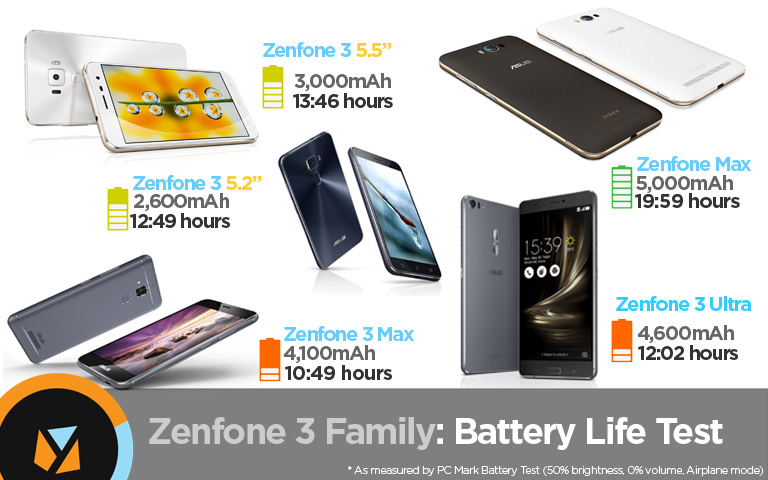
Even the scores of the 5.2-inch and 5.5-inch Zenfone 3 were a bit better by 20 to 30% compared to the Zenfone 3 Max. Even the Zenfone 3 Ultra with its huge 6.8 full HD display was 10% better (although it had 500mAh more battery capacity). The only model that we have not really tested in the Zenfone 3 Deluxe which we think would get the same scores as the Zenfone 3.
Looking at the entire family of the Zenfone 3, it looks like the Zenfone 3 Max is the least performing in terms of battery life.
The only possible reason for these results could be due to the MediaTek MT6753T chip that is used in the Zenfone 3 Max. The chip isn’t really built for optimal battery performance compared to its Qualcomm counterparts.
* The MediaTek MT6737 is built on an older 28nm semiconductor size while the Snapdragon 625 is now on the more power-efficient 14nm process.
* The MediaTek MT6737 does not use the big.Little technology. This power-optimization technology works by using high-performance ARM CPU cores combined with the most efficient ARM CPU cores to deliver peak-performance capacity, higher sustained performance, and increased parallel processing performance, at significantly lower average power. This means that for smaller tasks where a low-power core would be handling, the MT6737 still uses the ARM-A53 1.25GHz to handle it, eating up more battery in the process.
You can read more about the Zenfone 3 Max first impressions here.






mas ok pa ata ung zenfone laser 5.5s??