
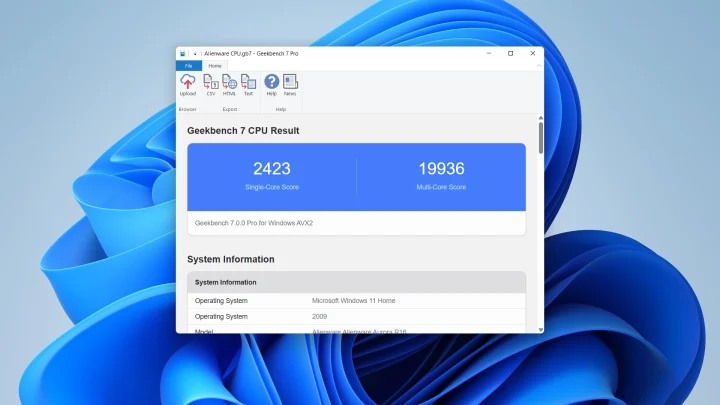
What’s new in Geekbench 7
- New media workloads for AV1 video encoding, Opus audio compression, and Whisper-powered live captions
- Smarter multi-core benchmark that better reflects real-world application performance
- New GPU tests focused on AI, machine learning, and content creation
- CUDA support added alongside OpenCL, Vulkan, and Metal
- New Game Physics benchmark powered by the Jolt Physics engine
- Updated photo editing and photo library workloads
- Larger datasets for file compression, PDF viewing, and image processing tests
- Available now for Android, iOS, Windows, macOS, and Linux
Primate Labs has officially released Geekbench 7, the latest version of its cross-platform benchmarking tool for measuring CPU and GPU performance across smartphones, tablets, and computers.
Available now for Android, iOS, Windows, macOS, and Linux, Geekbench 7 introduces new workloads designed to better reflect modern computing tasks, along with updates to its multi-core and GPU benchmarking systems.
One of the biggest additions is a new set of media workloads that measure CPU performance during common tasks such as audio and video encoding, decoding, and processing. These include AV1 screen-sharing video encoding, Opus audio compression, and video playback with live caption generation using the Whisper speech recognition model.
Geekbench 7 also adds a new Game Physics workload built on the Jolt Physics engine, expands its Photo Editor benchmark with more complex image editing tasks, and updates the Photo Library workload to support modern image formats including JPEG XL and DNG.
The multi-core benchmark has also been redesigned to better represent how applications actually use multiple CPU cores. Instead of forcing every workload to run across all available cores, Geekbench 7 only runs workloads in multi-threaded mode if the real-world application being modeled also uses multiple threads.
On the GPU side, Geekbench 7 shifts its focus toward machine learning and content creation workloads. New tests include AI-powered face tracking and video filters, image upscaling, virtual background processing for video calls, RAW image processing, LUT-based video color grading, path tracing, and fluid simulation.
Primate Labs has also added CUDA support to the GPU benchmark, joining OpenCL, Vulkan, and Metal as supported graphics APIs.
In addition, Geekbench 7 uses larger and more demanding datasets across several workloads, including file compression, PDF viewing, software development, and image processing, to better reflect modern applications and file sizes.
Geekbench 7 is available as a free download for personal use. To mark its release, Primate Labs is offering 20% off Geekbench 7 Pro through its online store until August 6.




0 Comments
Leave a Reply