

Smartphone battery capacity is rapidly increasing in 2026, with new data showing a significant shift toward larger batteries and emerging technologies.

According to a recent industry report, the global average smartphone battery capacity reached 5,291mAh in January 2026, marking a roughly 400mAh increase year-over-year; the biggest jump since late 2021.
Devices equipped with 6000mAh or larger batteries are also gaining traction, now accounting for 29% of global smartphone sales, up sharply from just 10% a year earlier.
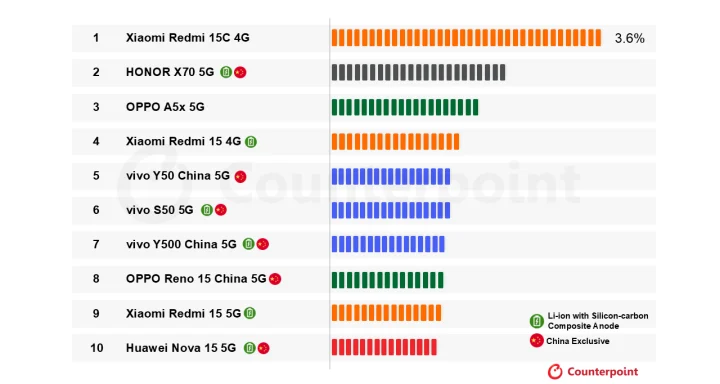
This growth is largely driven by Chinese smartphone manufacturers, which continue to prioritize battery life as a key selling point. Brands such as Xiaomi, vivo, OPPO, and HONOR dominated the segment, occupying all spots in the top 10 best-selling smartphones with large batteries.
Among them, the Xiaomi Redmi 15C 4G emerged as the top performer in the category, capturing a 3.6% market share thanks to its affordability and wide availability.
Meanwhile, the HONOR X70 5G stood out with the highest battery capacity in the segment, featuring an 8300mAh battery paired with fast charging support.
A key factor behind this trend is the growing adoption of silicon-carbon battery technology, which allows manufacturers to increase battery capacity without significantly increasing device thickness or weight. Six of the top 10 models in the segment already use this technology.
However, many of these high-capacity devices remain limited to the Chinese market due to global regulations and certification constraints around battery sizes. This has created a noticeable gap, with China reportedly leading by more than 1000mAh in average smartphone battery capacity compared to other regions.
Looking ahead, battery capacities are expected to continue increasing, though at a slower pace, as manufacturers balance performance upgrades with rising production costs and supply constraints.




0 Comments
Leave a Reply