

We recently featured Lenovo’s new duo of affordable laptops with a form factor of an ultrabook. Just a week after the launch, the folks from Lenovo sent us an IdeaPad S300 to take out for a spin. Catch our review of the Lenovo IdeaPad S300 after the break.
Design and Construction
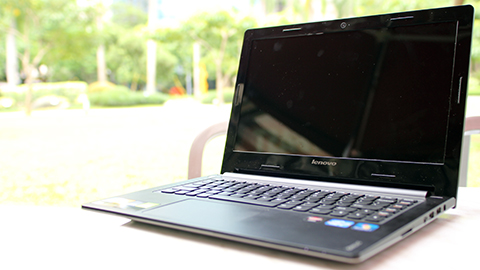
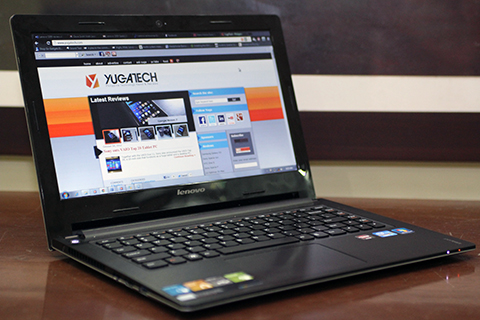
The IdeaPad S300 has a minimalist, two-tone body which is coated with “tactile metal finish†except the the bezel around the screen which has glossy finish. Lifting the lid will reveal the laptop’s 13.3†HD display and an uncluttered keyboard layout. Situated at the upper right hand corner is the power button which also doubles as a notification light for the laptop’s current status. Of course, there’s the keyboard and the clickpad below it, but we’ll get back to that on the latter part of our review.
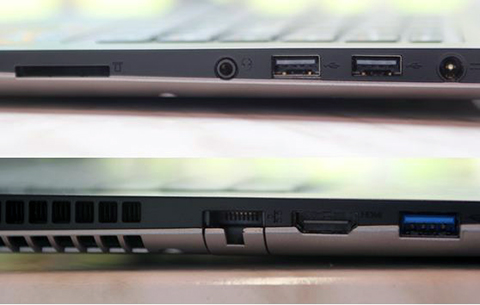
On the left side is an air vent in the between the One-Key Recovery button (that launches CyberLink System Recovery and other recovery options) and the collapsible RJ-45 port. The Ethernet port is accompanied by two other ports which are USB 3.0 and HDMI. On the other side are a couple of USB 2.0 ports, an audio jack and an SD card slot and the AC port.
Multimedia
This ultra-slim laptop is equipped with a 13.3†HD (1366 x 768) display with an aspect ratio 16:9. It’s not the best in its class in terms of display quality but should suffice for your basic computing needs.
As for the audio part, the IdeaPad S300 has a fairly loud sound output compared to other laptops. For some weird reason though, the sound quality is a bit muffled as if there’s something clogging the speakers.
Keyboard and ClickPad
Although the keyboard layout of this laptop bears some resemblance to that of the ASUS A46 Slimbook’s in terms of spacing and tactile feedback, we prefer the S300’s keyboard over the other as it follows a more conventional approach in the arrangement and sizing of the keys especially on those keys we typically use. This makes up for a more comfortable typing experience with lesser likelihood of mistypes.
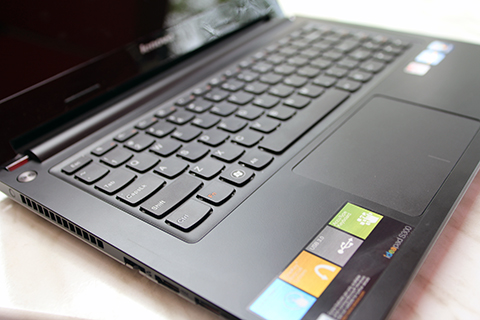
In addition to the well-arranged and evenly-spaced rounded keys, the machine also provides a spacious palm rest for an added comfort when you’re using the keyboard. In the middle of the palm rest is an ample-sized ClickPad which we find very responsive and has multi-finger and gesture support for scrolling and zooming.
Lenovo IdeaPad S300 specs:
Note: The specs is based on the review unit that was sent to us. Configuration may vary depending on availability, location and price.
13.3†16:9 HD LED display
Intel Core i5-3317U Processor (3M Cache, 1.70 GHz – 2.60GHz)
4GB DDR3 RAM @1600MHz
Intel HD 4000 Graphics + AMD Radeon HD 7450M (optional)
500GB @ 7200 SATA II + 32GB SSD (Optional)
WiFi 802.11 a/b/g/n
Gigabit LAN 1000Mbps
Bluetooth 4.0 + HS
HDMI port
LAN port
1 x USB 3.0 and 2x USB 2.0
2-in-1 card reader (SD/MMC)
HD Webcam
4-cell Battery (up to 5hours)
Windows Home Premium 64-bit
Dimension (W x D x H): 330 x 230.2 x 22.4mm
Weight: 3.70lbs
Performance and Battery Life
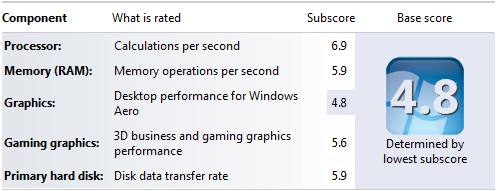
Having a 3rd Generation Intel Core i5 processor definitely has its perk and one of it is the ability to carry out almost any task that we threw at it without breaking a sweat. That’s exactly what we experienced with the S300. And thanks to its AMD Radeon HD 7450M, the slim machine was able to handle some tasking apps quite satisfactorily. Here is a snapshot of S300’s Windows Experience Index scores:
The battery life that we got from this laptop is actually close to what Lenovo had promised, sometimes even exceeding it. On moderate use, we averaged at around 4:30 – 5:30 hours worth of juice on a single full charge. Lenovo has included a pre-installed software called Energy Management to aid users to get more out of their battery.
Conclusion
It’s undeniable that the Lenovo is banking on the IdeaPad S300’s 22.4mm thin form factor and its affordable price tag to gain market traction. Taking those two factors in to consideration, we think that Lenovo will have a great shot at the budget-conscious consumers by giving them a taste of ultrabook’s portability without having to shell out a ton cash for it.
What we liked about it:
â— Thin and light
â— Comfortable keyboard
â— Good battery life
What we did not like:
â— Low display resolution for its size
Editor’s Note: Apparently, the review unit sent to us is an Intel Core i5 processor but the actual unit that will be sold locally wil use an Intel Pentium Dual-Core (priced at Php21,995). Hence reports on WEI and overall performance may vary significantly. We will do a follow-up once the actual units are released.






I have been using a Lenovo S300 for a year now. Initially installed with Win7, it performed badly even with basic usage (e.g. multi-tab browsing, emails, Office suite). I upgraded it to Win8.1 and its performance significantly improved to the point that it works sufficiently well for personal and work use. But the serious problem of S300 is that it is poorly designed & constructed that its hinge breaks its plastic case. It even affects the power jack beside the hinge.