
We’ve been told by the office of Sen. Bam Aquino that PLDT has finally agreed to be part of the local IP peering group, Philippine Open Internet Exchange (PHOpenIX), which is maintained by DOST ASTI (Advanced Science and Technology Institute).
PHOpenIX is the only Exchange in the Philippine Internet industry operated by a neutral institution that allows the exchanges of Internet traffic in a free-market environment among local internet and data service providers.

One of the biggest benefit when local ISPs are interconnected via the PHOpenIX is shorter transit time between a subscriber of one ISP to another subscriber of a competing provider. This is true with services and content that is hosted by one ISP that is accessed by a subscriber of a competing provider will also be faster as the IP connection no longer goes out of the country and back. Gamers will also experience lower latency time when accessing game servers of members of the PHOpenIX.
Members of the PHOpenIX include Sky Broadband, Eastern Telecoms, Globe telecom, Birstop Networks, Comclark, Bayantel, DataOne, Akamai, PhilCom, BellTel, DataOne Asia and many others.
The only big player that has not joined the local IP peering is PLDT. This is the reason why some sectors are pointing at the telco why the internet in the Philippines is slow. PLDT has been resisting calls from the private and public sector to join the local peering group for the longest time.
This development will finally resolve that issue that has been the subject of debates and even a senate inquiry led by Sen. Bam Aquino.
The PHOpenIX has seen huge growth in traffic that goes thru the exchange.

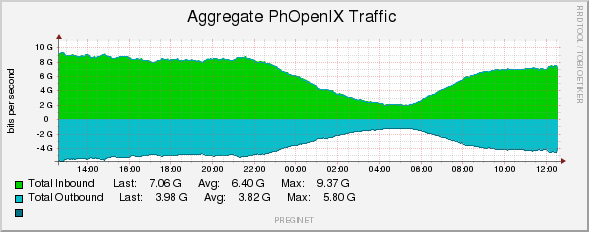
The current peering has seen traffic as high as 10Gbps going thru the exchange during peak hours. With PLDT joining the exchange, we will certainly see this traffic increase significantly.
We’ve been invited by the office of the senator to witness the signing of the MOA assigning the PHOpenIX as the official Government Internet Protocol Exchange as well as the signing of ASTI and PLDT to become the 3rd physical connection point of PHOpenIX.
We also wrote about “Why Internet is Slow and Expensive in the Philippines“.
Update: During the press briefing, we asked more details about the peering agreement. Read our story on “Details of PLDT’s IP Peering Agreement with PHOpenIX“.






This news is misleading! PLDT still won’t peer with other service providers. According to the link below, the agreement does NOT mean that PLDT will directly peer with local competitors, it still marks a start according to the government.
“Then again hindi pa ito yung IP peering na ninanais natin pero (…this is NOT the IP peering we’ve been wanting but) we are now one step closer now that a big player like PLDT is part of the open IX,” Sen. Bam Aquino, who has been spurring ICT connectivity, said.
PLDT, for its part, said they are also closely working to iron out certain issues with regard to local peering.
“Our intent is to fully support IP peering but to achieve this we need to discuss various issues including security,” Ray Espinosa, PLDT director and head of regulatory affairs, said.
http://www.interaksyon.com/infotech/access-to-government-websites-to-improve-with-dost-pldt-agreement
You need to read our coverage of the MOA signing here with details of our interview — http://www.yugatech.com/telecoms/details-of-pldts-ip-peering-agreement-with-phopenix/