

DJI’s Osmo Pocket series has long been one of the most popular options for creators looking for a compact camera with built-in stabilization. Since its debut in 2018, the lineup has steadily evolved from a simple handheld gimbal camera into a more capable tool for vloggers, travelers, and mobile content creators.
A major leap came with the Osmo Pocket 3, which introduced a larger 1-inch sensor and a rotating touchscreen, significantly improving both usability and image quality. That release set a new benchmark for what a pocket-sized camera could deliver.
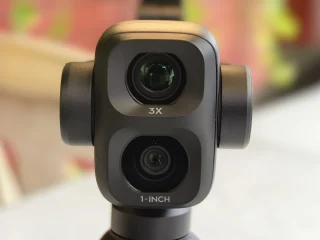
The DJI Osmo Pocket 4P builds on that foundation. While it retains the familiar compact form factor, it introduces a dual-camera system, an extended hybrid zoom range, improved tracking features, and new accessories designed to expand shooting versatility.
I spent some time using the device in real-world conditions to see how these upgrades perform in actual use.
Design and build quality
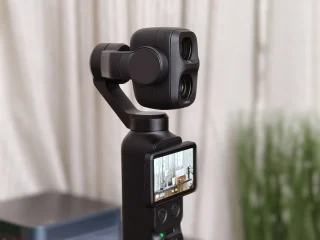
At first glance, the DJI Osmo Pocket 4P still carries the familiar DNA of the Osmo Pocket lineup, but it is noticeably different from the Pocket 3 and earlier models. It is slightly larger, and the addition of the dual-lens setup gives it a distinct look that sets it apart from previous iterations. Despite these changes, it still retains the core identity of the Osmo Pocket series as a compact, gimbal-style camera built for portability and quick deployment.
In hand, the most immediate difference is the weight. The Pocket 4P feels slightly heavier compared to earlier models, likely due to the addition of a second camera system and upgraded internal components. It is also slightly larger, though still compact enough to remain genuinely portable.
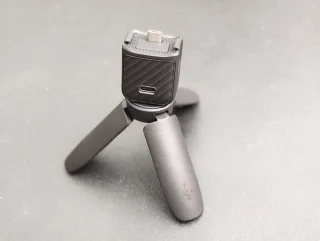
Despite these changes, handling remains comfortable. The experience improves further when using the battery handle and mini tripod, which provide better balance and stability during longer shooting sessions.
Overall, DJI maintains the core identity of the Osmo Pocket series: a compact stabilized camera designed for quick, handheld content creation.
What’s new
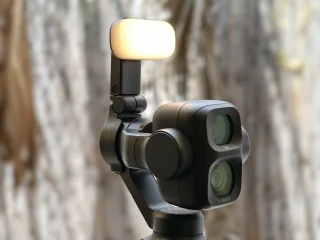
The biggest hardware change is the addition of a dual-camera system, which pairs a wide-angle main lens with a 60mm medium telephoto lens. This setup allows users to switch between standard framing and tighter compositions without relying entirely on digital zoom.
This dual-lens configuration also powers the Pocket 4P’s hybrid zoom system, which reaches up to 12x zoom in video mode. Instead of relying purely on digital magnification, the system combines optical switching between lenses, sensor cropping, and computational image processing to extend usable reach while maintaining detail.
In practice, this makes the camera significantly more flexible for distant subjects such as concerts, travel scenes, and events.
Another key addition is ActiveTrack 8.0, DJI’s latest subject tracking system. Based on testing, tracking feels faster and more stable, especially when following moving subjects during walking or running shots.
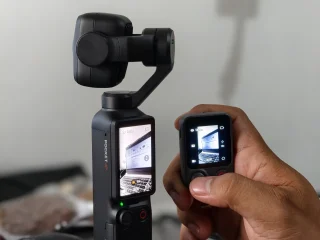
A new accessory, the Viewfinder Remote, also expands usability by allowing live preview, framing control, zoom adjustment, and recording from a distance—useful for solo creators or mounted setups.
Video quality
Video performance is one of the strongest aspects of the Osmo Pocket 4P.
Footage captured in daylight is sharp, detailed, and features natural color reproduction. DJI’s use of a 1-inch sensor plays a major role in maintaining dynamic range and overall image quality, particularly in scenes with mixed lighting.
The camera also supports high frame-rate recording, including 4K up to 240fps, enabling detailed slow-motion footage for more cinematic results.
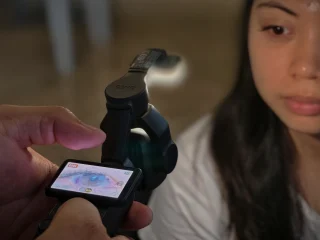
Low-light performance is also solid. In my testing under uneven and dim environments, the camera was able to retain detail while keeping noise under control. Colors remained balanced, and footage stayed usable without excessive softening.
Stabilization continues to be one of DJI’s strongest advantages. The 3-axis mechanical gimbal system physically stabilizes movement, resulting in consistently smooth footage even during fast motion.
During one test, I recorded a subject while both of us were running. After locking onto the subject’s face using ActiveTrack, the camera maintained stable framing and smooth motion throughout the movement.
Autofocus performance is also reliable, with consistent subject tracking and minimal focus hunting across both close and distant subjects.
One minor observation was a brief hesitation when switching from 12x zoom back to 1x, likely due to recalibration between lens switching and focus adjustment.
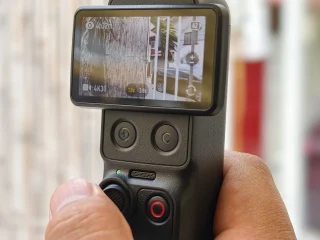
Photo quality
While the Osmo Pocket series is primarily designed for video, the Pocket 4P still delivers capable still image performance.
Photos taken in daylight show good sharpness, natural colors, and solid dynamic range, helped by the 1-inch sensor which preserves detail in both highlights and shadows.
In low-light conditions, images remain usable with controlled noise levels and acceptable detail retention.
One limitation to note is zoom behavior in photo mode. While video mode supports up to 12x hybrid zoom, still photography is limited to around 9x zoom, likely due to sensor cropping and processing constraints to maintain image quality.
The inclusion of the telephoto lens improves portrait flexibility, allowing more natural subject separation compared to relying solely on wide-angle digital zoom.
Features and software
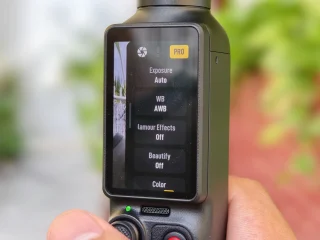
The touchscreen interface remains responsive and easy to use, with smooth navigation across shooting modes, settings, and playback.
One of the more practical additions is the Viewfinder Remote, which enables full remote control of the camera, including live preview and framing adjustments—ideal for solo shooting setups.
The camera also benefits from ActiveTrack 8.0, which improves subject detection and tracking stability, especially in motion-heavy scenarios.
For audio, the Vlog Combo includes the DJI Mic 2, which delivers clear and stable wireless audio suitable for vlogging and interviews. However, at this price point, the inclusion of a newer microphone system would have made the package more complete.
In terms of thermals, the camera does warm up during extended recording sessions. While it does not reach uncomfortable levels, heat buildup is noticeable due to continuous sensor processing, stabilization, and tracking functions.
Battery life
Battery life is sufficient for typical shooting sessions, especially for short-form content creation. The included battery handle in the Vlog Combo helps extend usage time, making it more suitable for longer shoots or travel.
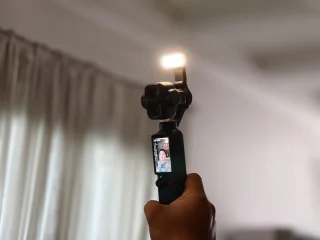
However, since the camera now supports multiple accessories like the Viewfinder Remote and fill light, battery consumption can increase depending on your setup. Charging is still straightforward, and no major battery issues were observed during testing.
What’s in the box
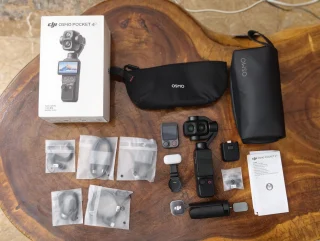
The DJI Osmo Pocket 4P is available in two configurations: Standard Combo and Vlog Combo.
The Standard Combo includes the camera unit and essential accessories for basic use.
The Vlog Combo adds several accessories aimed at content creators, including:
- DJI Mic 2 wireless microphone
- Battery handle (extended grip + battery)
- Fill Light
- Mini tripod
- Viewfinder Remote
- USB-C cable and protective accessories
For creators planning regular use, the Vlog Combo offers a more complete out-of-the-box setup.
Price and availability
The DJI Osmo Pocket 4P is priced at ₱37,790 for the Standard Combo and ₱42,290 for the Vlog Combo.
While it sits in the premium segment of compact cameras, the combination of a dual-camera system, 12x hybrid zoom in video / 9x max in photo, 1-inch sensor, mechanical stabilization, and improved tracking positions it as one of the more versatile pocket cameras in its class.
Conclusion
The DJI Osmo Pocket 4P builds on the strengths of previous Osmo Pocket models with focused upgrades that improve overall versatility.
The addition of a dual-camera system and 12x hybrid zoom significantly expands its usability, especially for capturing distant subjects where earlier models were more limited. Combined with improved tracking, reliable autofocus, and strong stabilization, it delivers a more flexible shooting experience in a compact form factor.
Based on my hands-on use, the improvements are most noticeable in zoom capability, framing flexibility, and tracking performance rather than a complete overhaul in core image quality.
For users upgrading from the Osmo Pocket 3, the changes are meaningful, particularly if extended reach and dual-lens flexibility are priorities.
However, for users who primarily shoot casual vlogs or selfie-style content, the upgrade may not feel essential.
Overall, the Osmo Pocket 4P continues DJI’s refinement of the series, balancing portability with expanded creative tools for mobile content creators.
DJI Osmo Pocket 4P specs:
Dual-camera system (1-inch Wide + 1/1.3-inch Medium Tele)
20mm Wide Camera (f/2.0)
60mm Medium Tele Camera (f/1.8)
Up to 17 Stops Dynamic Range
4K 240fps (Wide) / 4K 200fps (Tele)
Intelligent AF with Full-Pixel PDAF
New ActiveTrack (up to 12x zoom)
2-inch OLED Touchscreen
103GB Built-in Storage
Up to 210-minute Battery Life
80% Charge in 18 Minutes
Supports Vertical Shooting

0 Comments
Leave a Reply