

For years, local telcos have fought over the reigning king of fastest download speeds. However, a new report from network tracking company Ookla shows that these long-revered download speeds aren’t so important for smartphone AI use, as they won’t tell you if your phone can handle AI features smoothly.

Instead, running real-time AI tools depends on things that download speeds never test – like how fast you can upload data, how well the connection holds up when a lot of people are online, and how steadily your phone stays connected to the cloud.
The biggest problem for Filipino users is that local mobile networks were built for watching videos and browsing social media, where you mostly pull data down to your screen. AI completely flips this around. While normal video streaming uses mostly downloads, text-based AI models run on a 29/71% upload-to-download ratio, and conversational voice assistants push that demand closer to a 50/50 split.
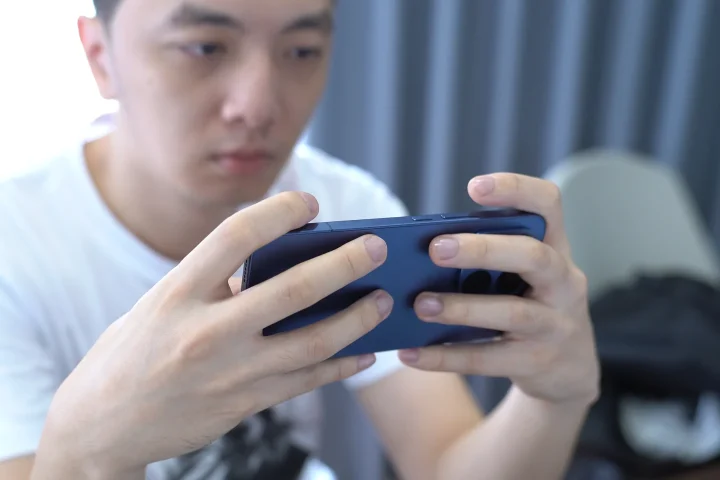
Because local telcos only dedicate around 9% of their total network space to uploads, our median 5G upload speed sits at a low 11.97 Mbps. This creates a tight bottleneck the moment you try to upload a heavy voice recording or live camera feed.
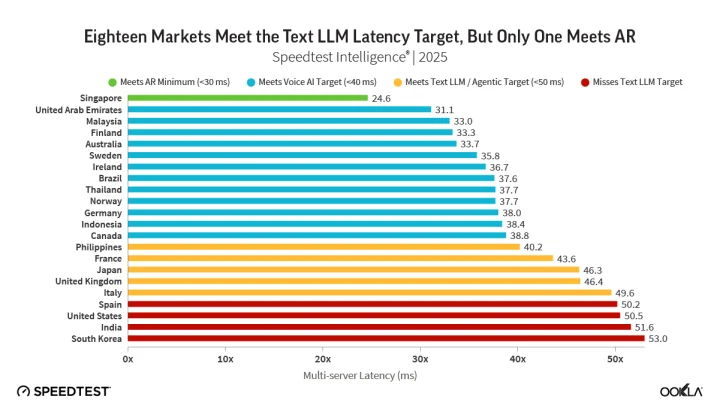
If you’re just typing basic text messages back and forth with an AI like ChatGPT, the Philippines actually does okay. The country ranks 14th out of 22 global markets tested. That keeps its standard delay at 40.2 milliseconds, which is fast enough to beat the 50-millisecond limit required to keep text chats fluid. But while our local cell towers can handle simple text conversations, they quickly start to struggle the moment you try to use more advanced tools: like having a live, spoken conversation with an AI assistant.
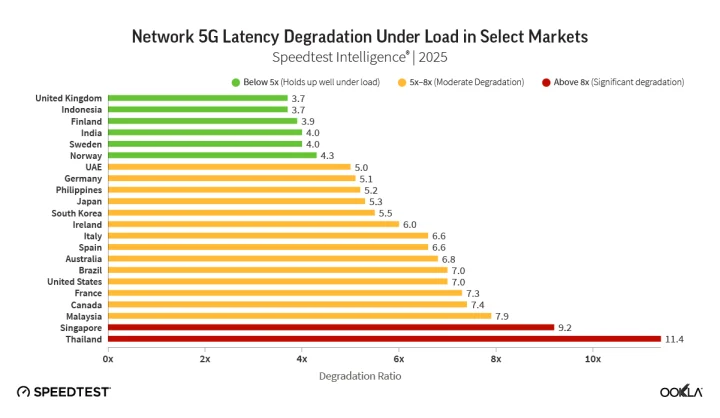
When a lot of people get online at the same time, the local network slows down drastically. During peak hours on a crowded city street, the time it takes for data to travel jumps by 5.2 times the normal rate. For a normal user, this means an AI voice assistant will stutter, lag, or completely drop the connection. The network completely hits a wall if you try to use smart glasses or live video AI, which require a sub-10-millisecond latency and at least 20 Mbps upload speeds to work without throwing off the user.
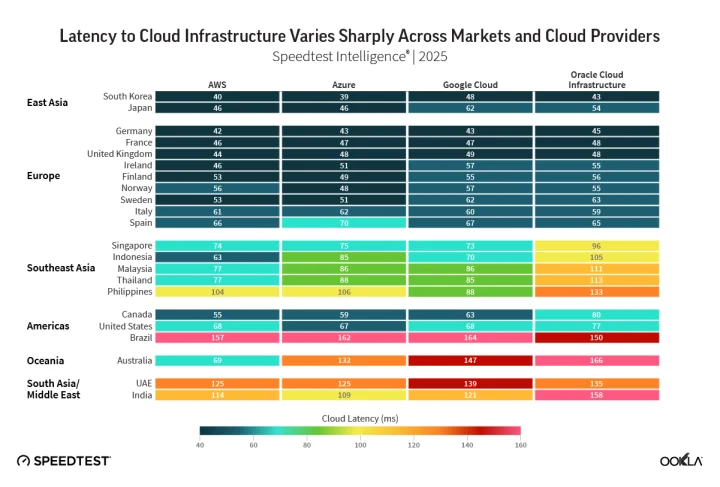
Even if the cell tower closest to your house is working perfectly, the data still has to travel from your phone to giant data centers overseas where the AI’s brain actually lives. The report reveals that the Philippines has the most unstable cloud connection timing in the world, with delay fluctuations swinging to a massive 34.9 milliseconds at the 90th percentile. This massive jumping around in connection timing means that data packets arrive at the servers at completely unpredictable speeds. In the real world, this makes your AI tools feel incredibly moody, working instantly one second and completely freezing up the next.
For a local smartphone market that is already being flooded with new AI-powered phones, these findings are a major reality check. To actually let Filipinos use the cool AI features being advertised today, local phone networks need to shift their focus from just raw download speeds. Instead, they need to focus on building up upload speeds, upgrading to true next-generation 5G standalone towers, and creating direct pipelines to major tech servers so that our data travels on a steady path.





0 Comments
Leave a Reply