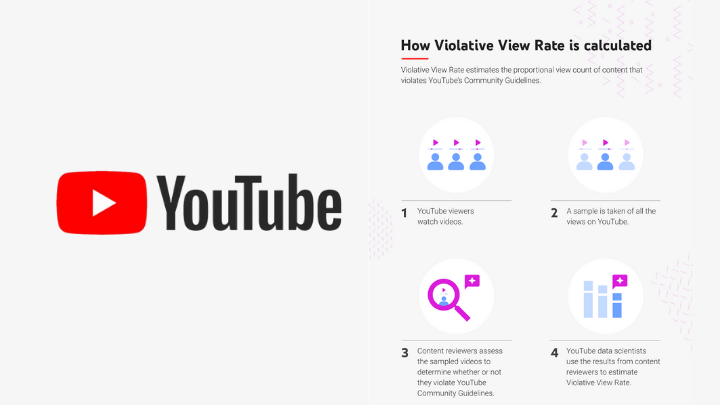

YouTube has recently introduced Violative View Rate (VVR), a new metric measuring how much of the views on the platform come from content violating its policies to improve transparency and accountability. It’s critical that our teams continually review and update our policies, work with experts, and remain transparent about the improvements in our enforcement work,” said Jennifer O’Connor, PM Director, Trust & Safety at YouTube. “We’re committed to these changes because they are good for our viewers and good for our business—violative content has no place on YouTube. Additionally, YouTube mentioned that the report has also been tracking the impact of the platform’s deep investment in machine learning technology, which can now detect 94% of all violative content on YouTube via automated flagging, 75% of which are removed before even receiving 10 views. The Violative View Rate is calculated by taking a sample of videos on YouTube and sending them to content reviewers who say which videos violate its policies and which don’t. The platform recognizes that this sampling method allows YouTube to have a more comprehensive view of violative content that its systems may not catch. The most recent VVR is at 0.16%-0.18%, which implies that out of every 10,000 views on YouTube, 16-18 come from violative content. Read more in our articles including "YouTube intros Violative View Rate metric for transparency and content accountability" and "Courier Complaints Drop 88% Under Oplan Bantay Padala".
YouTube has recently introduced Violative View Rate (VVR), a new metric measuring how much of…
Apr 12, 2021
The Department of Information and Communications Technology (DICT) reported a significant decline in courier-related complaints,…
Jun 25, 2026
The top model in the lineup is the ROG Zephyrus Duo GX651AX, described by ASUS…
Jun 25, 2026
Insta360 has officially launched the Luna Ultra in the Philippines. The camera is co-engineered with…
Jun 24, 2026
After being spotted in Lazada, the Infinix HOT 70 is now available in the Philippines.…
Jun 24, 2026
Google has announced new updates to Chrome Autofill. With this feature, it brings support for…
Jun 24, 2026YouTube has recently introduced Violative View Rate (VVR), a new metric measuring how much of the views on the platform come from content violating its policies to improve transparency and accountability. It’s critical that our teams continually review and update our policies, work with experts, and remain transparent about the improvements in our enforcement work,” said Jennifer O’Connor, PM Director, Trust & Safety at YouTube.
“We’re committed to these changes because they are good for our viewers and good for our business—violative content has no place on YouTube. Additionally, YouTube mentioned that the report has also been tracking the impact of the platform’s deep investment in machine learning technology, which can now detect 94% of all violative content on YouTube via automated flagging, 75% of which are removed before even receiving 10 views. The Violative View Rate is calculated by taking a sample of videos on YouTube and sending them to content reviewers who say which videos violate its policies and which don’t.
Our coverage of YouTube Violative View Rate includes: "YouTube intros Violative View Rate metric for transparency and content accountability"; "Courier Complaints Drop 88% Under Oplan Bantay Padala"; "ASUS ROG Zephyrus Duo and Zephyurus G now officially available in PH". Each article provides unique insights and information.