
Flagship smartphones have reached a point where meaningful upgrades are harder to come by. Most of the fundamentals are already excellent, and improvements often arrive in smaller, more focused updates each year.
That’s largely the story with the Samsung Galaxy S26 Ultra.

At first glance, it doesn’t look dramatically different from its predecessor. The design is familiar, the camera setup appears largely unchanged, and the battery capacity is still the same.
But Samsung has introduced a few interesting refinements this time around, most notably a new Privacy Display feature, an updated Snapdragon chipset, and a handful of AI-powered software tools.
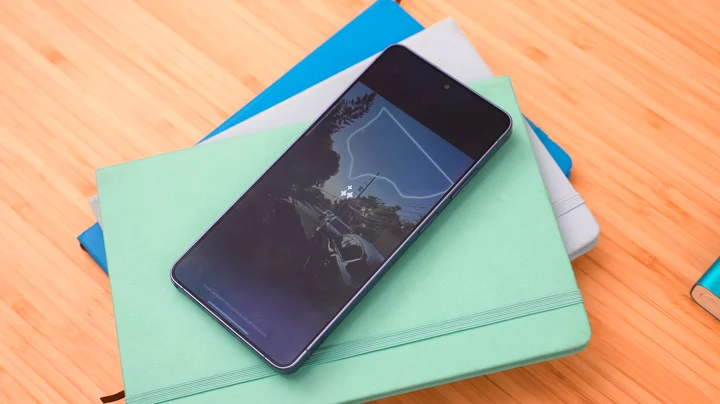
Although, like many modern smartphones, these additions come with trade-offs. Some improvements are genuinely useful, while others might not matter to everyone.
Design and Construction
The Galaxy S26 Ultra maintains Samsung’s premium design language with subtle refinements rather than a complete overhaul. The device is slightly thinner and lighter than before, with more rounded corners that make it feel a bit more comfortable to hold despite its large footprint.
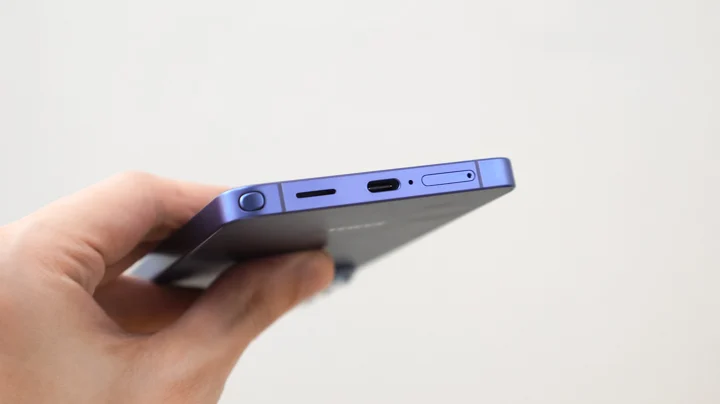
The frame now returns to aluminum rather than titanium. In daily use, this change doesn’t significantly affect durability or feel, but it does slightly alter the device’s premium perception. Then again, Apple did the same thing.
Either way, button ergonomics and build quality remains top tier overall for a plus-size handset featuring tried and tested materials with great construction.
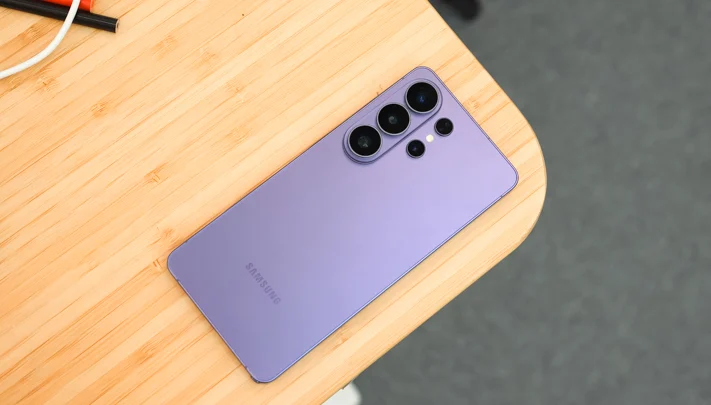
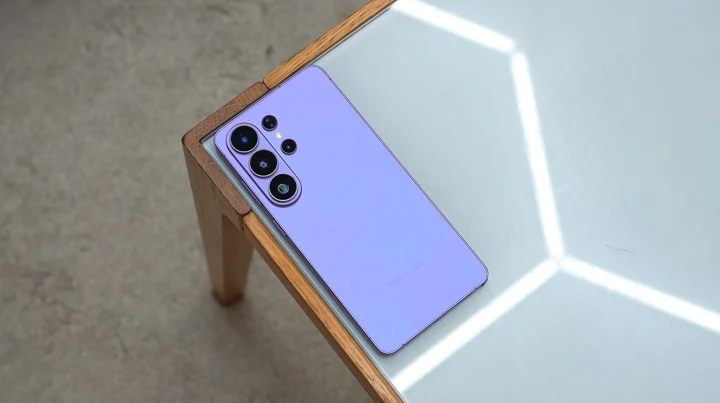
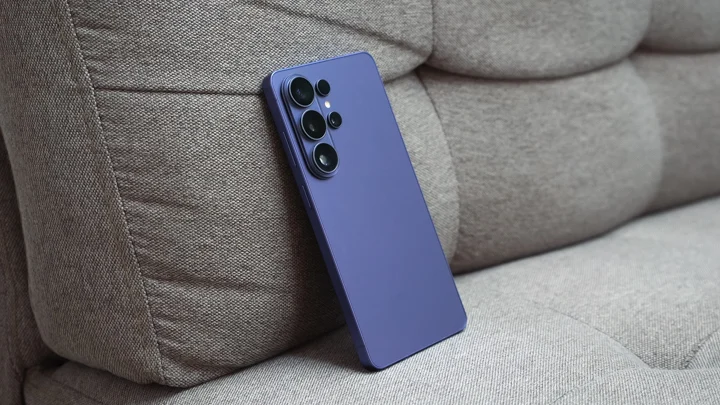
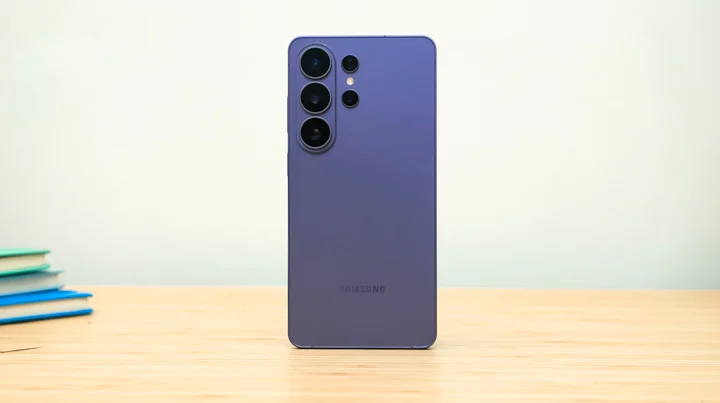
A more noticeable design change is the camera module. Instead of the individual camera rings sitting directly on the back panel, Samsung has introduced a raised vertical camera island with the rings sat on top.
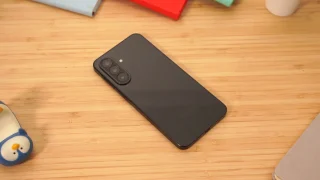
It gives the phone a more distinct look, but introduces so much wobble it absolutely eliminates the idea of being able to lay it flat on its back without a case.
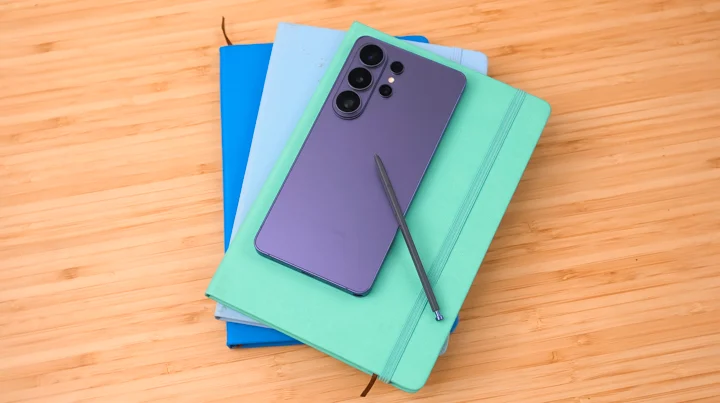
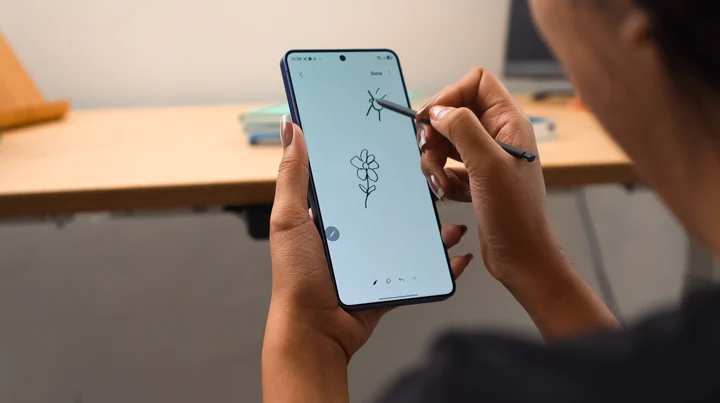
The S Pen also returns, still integrated into the body as expected, and again with no BT support. However, it features a new rounded corner design, and is slightly lighter and shorter.
Overall, the design feels like a refinement rather than a reinvention. It’s still unmistakably an Ultra device, but the changes are subtle and mostly focused on ergonomics.
Display, Multimedia and Biometrics
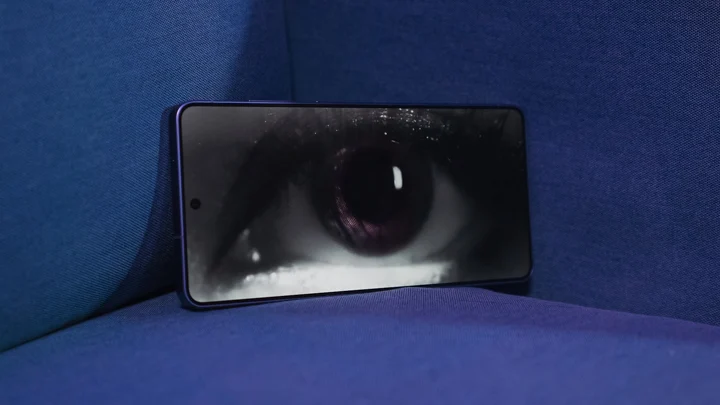
The Samsung Galaxy S26 Ultra features a large 6.9-inch QHD+ AMOLED panel with an adaptive refresh rate that ranges from 1 Hz to 120 Hz.
Colors are vibrant, contrast is excellent, and peak brightness is rated for 2600 nits just like last year. Outdoor visibility is strong, and the display still delivers a smooth and responsive experience whether you’re scrolling through social media or playing games.
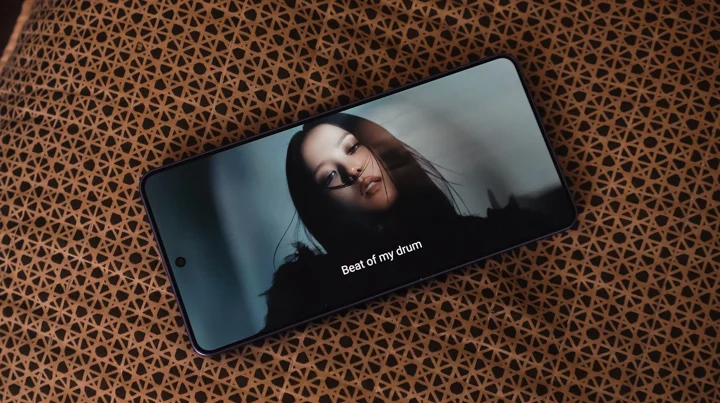
One of the most interesting additions this year is the Privacy Display feature. When enabled, it dramatically narrows the screen’s viewing angles to prevent people around you from seeing what’s on your screen.
Samsung achieves this by using two types of pixels on the display: wide-angle pixels that can be seen from most angles and narrow-angle pixels designed for direct viewing.
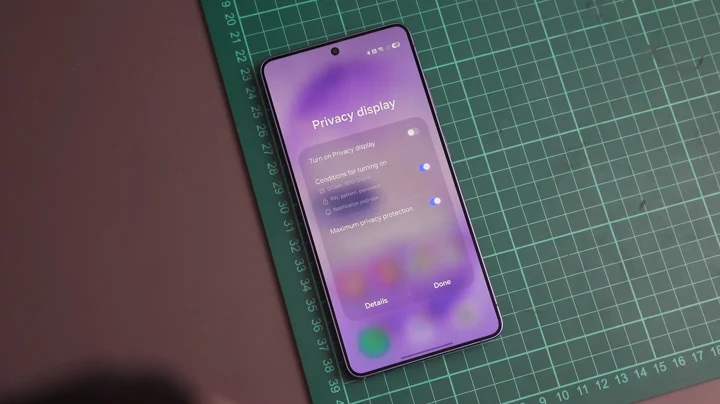
When Privacy Display is turned on, the wide-angle pixels are disabled, leaving only the narrow ones active.
It’s a clever solution, but it also illustrates the trade-offs involved. Because only half the pixels are active in this mode, resolution effectively drops and the display becomes slightly less sharp. Brightness can also dip slightly under certain conditions.
There’s even a max privacy mode that limits viewing angles even more in trade-off for, as the name suggests, even more ‘privacy’.
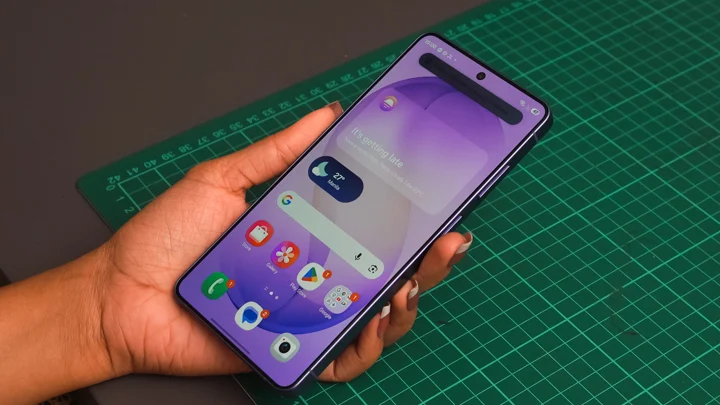
Even cooler than having a built-in privacy display is being able to set conditions for when it activates. Users can set it up to only turn on when entering PINs and passwords, when opening specific apps, and for notification pop-ups.
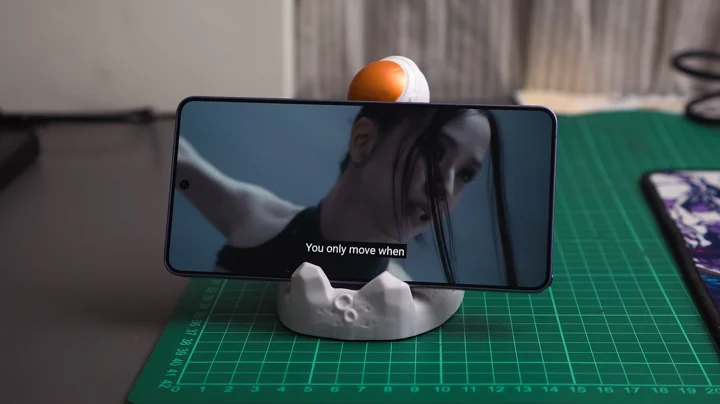
In normal use, the display still looks fantastic, and most users probably won’t notice these differences unless they’re specifically looking for them.
And just like last year, the media consumption experience has been great partly thanks to the phenomenal Dolby Atmos tuning in combination with its stereo speakers.
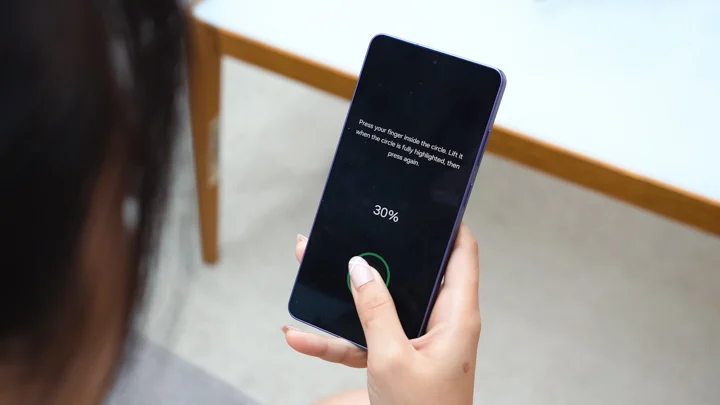
For biometrics, the S26 Ultra retains Samsung’s reliable ultrasonic in-display fingerprint scanner. It remains quick and accurate, and face unlock is also available for added convenience.
Cameras
The camera system on the Galaxy S26 Ultra largely carries over from the previous generation, though Samsung has made a few adjustments that subtly improve image quality.
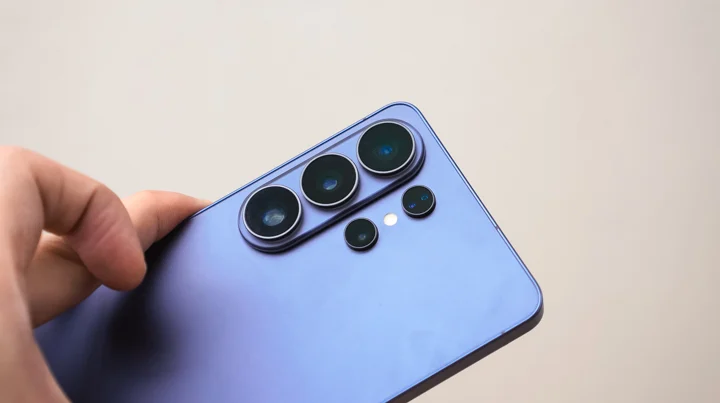
The 200MP main camera and 50MP periscope telephoto (5x optical) now features slightly wider apertures, allowing more light to reach the sensors. This results in improved low-light performance and more natural background blur in close-up shots.
But the trade-off for the above are further minimum focusing distances. So, if you’re someone upgrading from a Galaxy S-Ultra device within the past three generations, you probably won’t like having to be slightly further away from a subject compared to before, just to get that perfect focus.
In hindsight, most people picking up the S26 Ultra probably won’t notice?
Samsung Galaxy S26 Ultra Sample Photos
Mar 11 – 23


Overall image quality remains practically the same with slightly better post-processing in terms of skin tones and highlight preservation. Photos are detailed, dynamic range is good, and Samsung’s processing continues to produce vibrant yet balanced colors.
For video, Samsung introduced a new APV video codec that records near-lossless HDR video at up to 8K resolution at 30fps (or 4K 120fps).
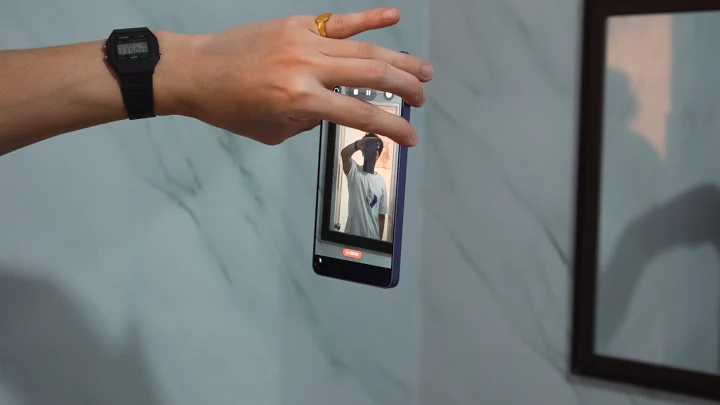
There’s also a new electronic stabilization feature called Horizon Lock, which keeps videos leveled even during very aggressive handheld shooting.
The feature takes advantage of the high-resolution sensor by cropping into the frame, producing incredibly stable footage without sacrificing too much detail.
While the hardware may not be dramatically different from last year, the cameras still deliver consistently great results across a wide range of shooting conditions.
OS, Apps and UI
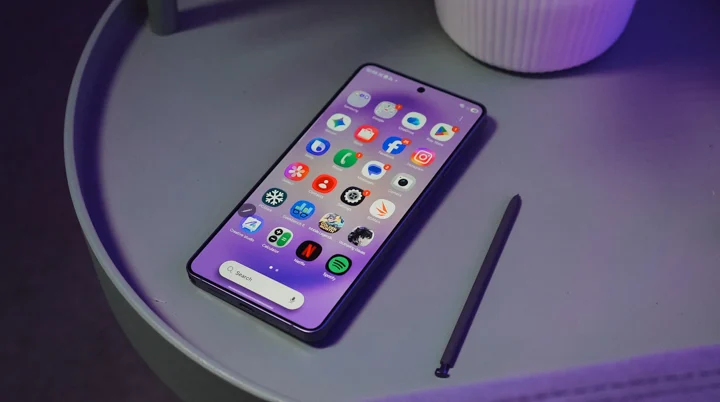
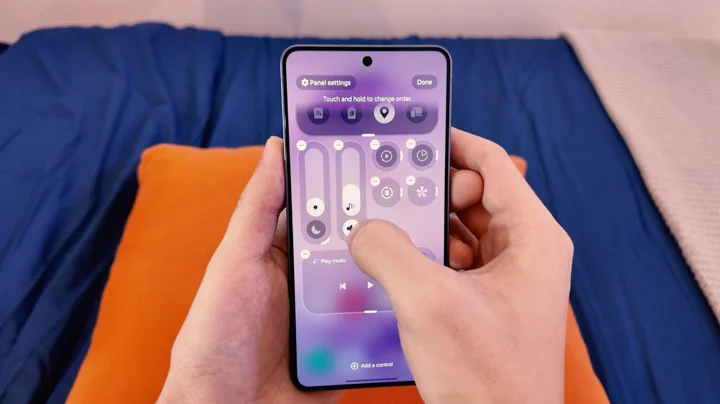
Out of the box, the Galaxy S26 Ultra runs the brand’s latest publicly available operating system, One UI 8.5 based on Android 16. The interface remains polished and feature-rich, with some useful new customization options for the Quick Panel.
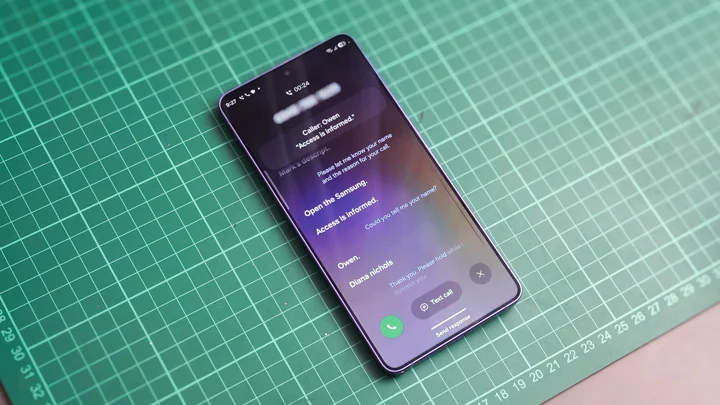
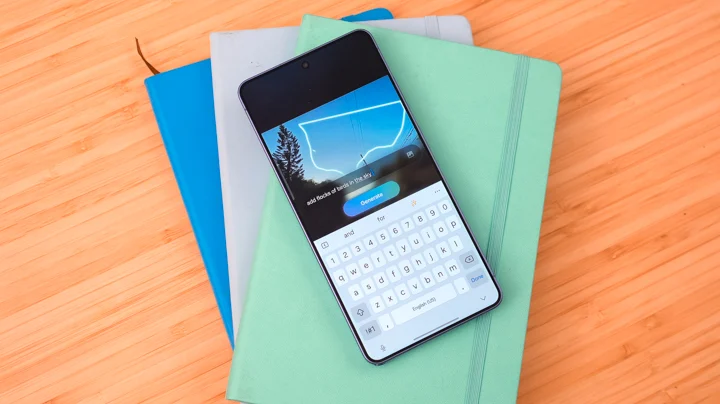
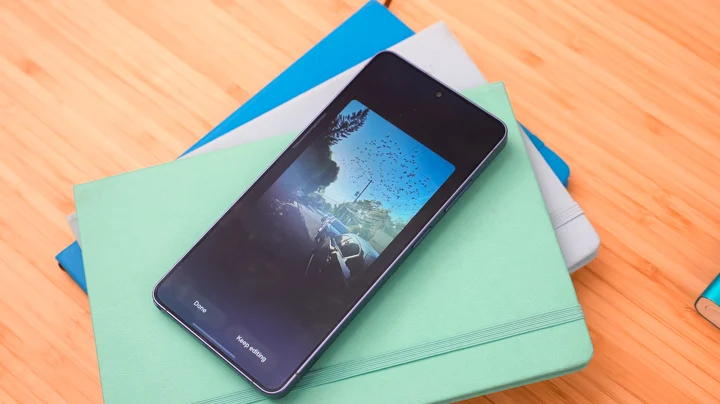
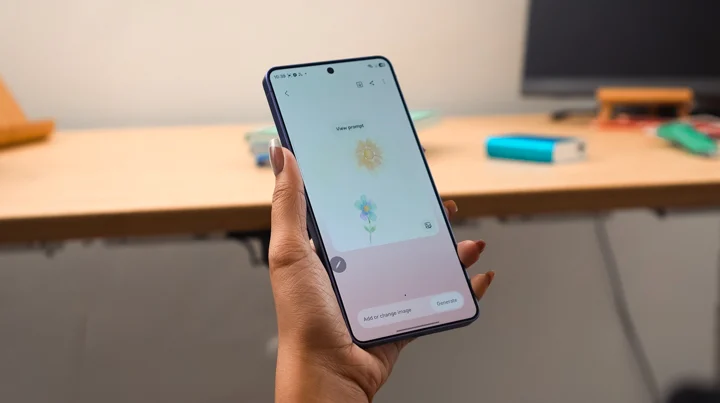
Samsung has also leaned heavily into AI features with this year’s S26 lineup, introducing several new tools across the system. These include call screening, audio noise removal when streaming videos, and generative photo editing tools that allow users to modify or expand images via text prompts.
Samsung Galaxy S26 Ultra Photo Assist Prompt editing Sample
Mar 11 – 15


Some of these features are genuinely useful, particularly AI call screening and maybe the latest version of Bixby, which now allows us to just adjust things like lowering the volume and brightness with just our voice.
But even that and others still feel more experimental or in their early stages, and not everyone will find them essential to their daily workflow.
Fortunately, most of these features are optional. Users can choose to use them frequently or ignore them entirely without affecting the core smartphone experience.
One UI itself remains smooth and intuitive, with Samsung continuing to refine its multitasking features and productivity tools.
And in terms of software support, just like last year, the entire Galaxy S26 lineup will be continuing the brand’s promise of 7 years of major OS updates and security patches.
Performance and Benchmarks
The brains behind the Galaxy S26 Ultra’s operations is the Qualcomm Snapdragon 8 Elite Gen 5 (Made for Galaxy). It’s a 3nm chipset that features an octa-core CPU capable of 4.74 GHz clockspeeds, and an Adreno 840 GPU.
Configurations come in 12GB of memory paired with either 256GB of 512GB of internal storage, or 16GB of RAM with 1TB of storage.
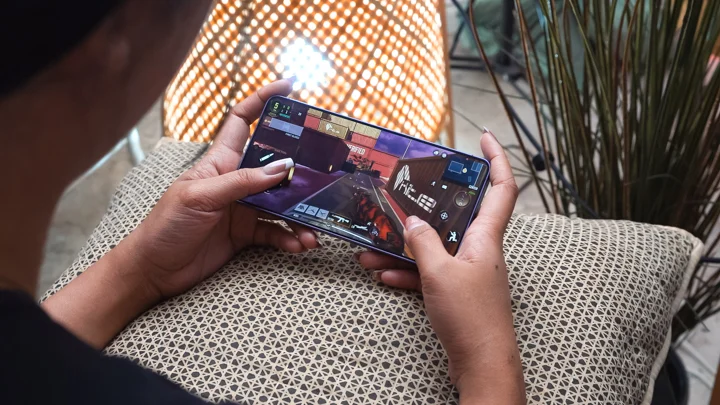
As expected, the phone handled our usual tasks for productivity and leisure with no issues. UI animations remain smooth, and the system itself remains responsive even under heavy workloads.
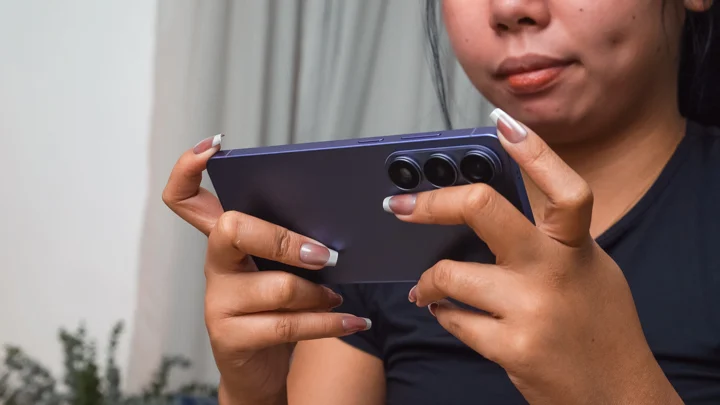
Gaming performance is equally strong. The phone can handle demanding titles without significant frame drops, and the updated vapor chamber cooling system helps maintain stable performance during extended sessions.
In Genshin Impact, we are easily able to max out our graphics settings with the framerate set to 60 fps.
In terms of benchmark numbers, the Samsung Galaxy S26 Ultra delivers top-tier flagship performance across the board, backed by extremely high benchmark results that translate well into real-world use.
Its Geekbench scores show excellent single-core performance, meaning everyday tasks like app launches, scrolling, and general responsiveness feel incredibly fast, while its multi-core performance is still strong enough for heavy workloads like video editing and multitasking.
| Device: | Samsung Galaxy S26 Ultra |
|---|---|
| Chipset: | Qualcomm Snapdragon 8 Elite Gen 5 (Made for Galaxy) |
| RAM | 12GB |
| Antutu v11 | 3,606,037 |
| Geekbench 6 Single-Core | 3,664 |
| Geekbench 6 Multi-Core | 10,979 |
| Geekbench 6 OpenCL | 23,104 |
| Geekbench 6 Vulkan | 25,236 |
| 3D Mark Wild Life | Maxed Out! (117-207 avg. FPS) |
| 3D Mark Wild Life Extreme | 7,610 (45.57 avg. FPS) |
| PCMark Work 3.0 | 20,670 |
| Antutu v11 Storage | 161,528 |
| Seq. Write | 4,042.6 MB/s |
| Seq. Read | 3615.8 MB/s |
On the graphics side, the device stands out even more, with maxed-out 3DMark results and high Vulkan scores indicating that it can handle demanding games at maximum settings with stable frame rates.
Storage speeds are equally impressive, offering fast read and write performance that benefits everything from app loading to high-resolution video workflows.
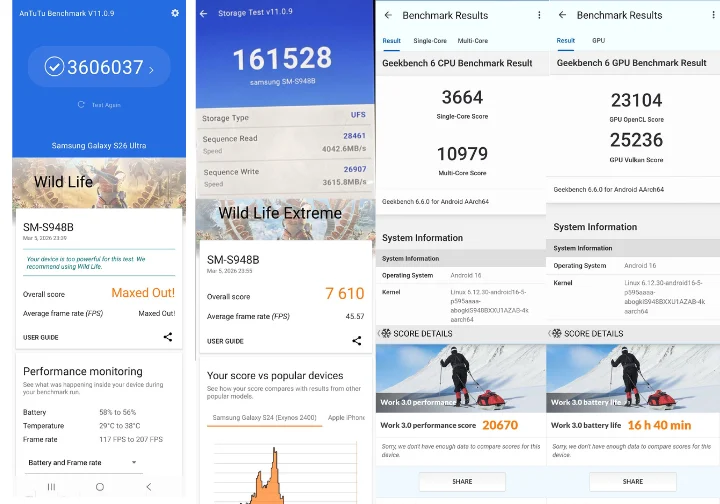
Overall, the S26 Ultra delivers a well-balanced, powerful experience that feels smooth, fast, and reliable in daily use, making it one of the most capable smartphones in its class.
Battery
Powering the Galaxy S26 Ultra is the same 5,000 mAh battery capacity as its predecessor, but improvements in chip efficiency and software optimization help deliver slightly better endurance.
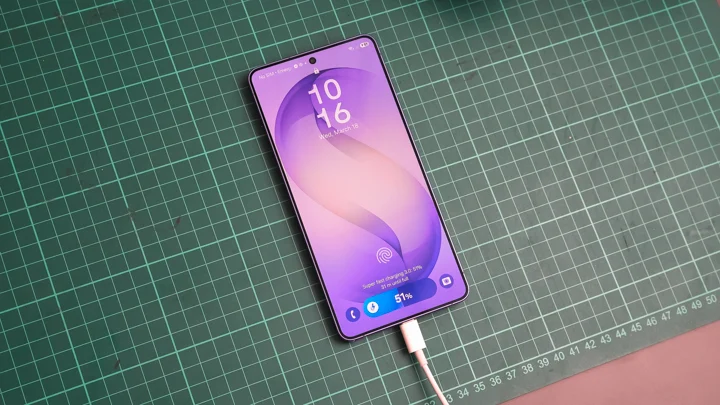
In our PCMark Work 3.0 Battery testing, our unit lasted 16 hours and 40 minutes.
In daily use, the phone comfortably lasts through a full day of moderate to heavy activity, including social media and internet browsing, messaging and calling over data or WiFi, snapping shots with the cameras, and video streaming.
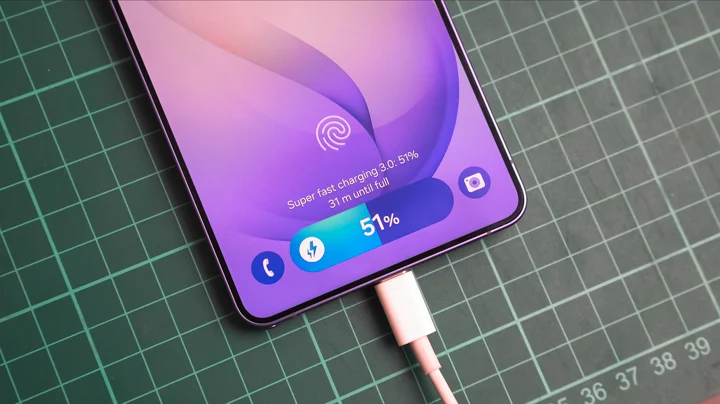
Charging speeds have improved, with the device now supporting faster 60W wired charging that can top up the battery in about 40 minutes under ideal conditions. There’s also 25W wireless charging which abide by Qi 2.2 standards, and the same 4.5W reverse-wireless charging.
One omission worth noting is the lack of Qi2 magnetic wireless charging support. While the phone still supports wireless charging, the built-in magnetic alignment, similar to that of the Pixel 10 series, is not present. Users who want that functionality will still need to rely on compatible cases.
That said, Samsung continues to take a conservative approach to battery technology. Unlike some competing devices, the S26 Ultra still does not adopt silicon-carbon battery technology, which has allowed other manufacturers to push capacity higher without increasing size.
For most users, the battery performance will still be more than adequate, but it does feel like an area where Samsung is choosing to play it safe over aggressively innovating.
Connectivity
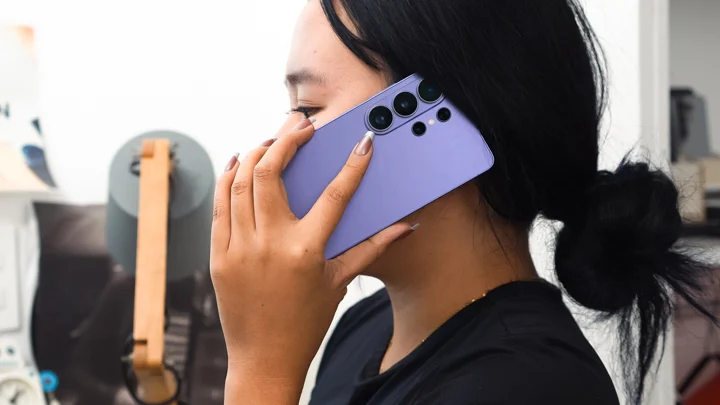
The Galaxy S26 Ultra offers a full suite of connectivity features expected from a flagship device. It supports 5G networks, Wi-Fi 7, Bluetooth 6, NFC, GPS, and ultra-wideband (UWB) for compatible accessories and tracking devices.
Call quality remains strong, and wireless performance is stable across both cellular and Wi-Fi connections.
Conclusion
The Samsung Galaxy S26 Ultra is, without question, one of the most capable smartphones available today. It combines a premium design, an excellent display, powerful performance, and a versatile camera system into a single device that excels in nearly every category.
At the same time, it also highlights the realities of modern flagship phones. Most upgrades are now refinements rather than dramatic leaps forward. Features like the Privacy Display and new AI tools add interesting capabilities, but they also come with trade-offs that not every user will prioritize.
For those already invested in Samsung’s ecosystem or looking for one of the most feature-packed smartphones available, the S26 Ultra remains an easy recommendation at the time of writing.
But it’s also a reminder that in today’s smartphone market, the biggest improvements do not often come from completely new ideas, but from carefully balancing the trade-offs that we get with them.
On a personal note, if Samsung is taking a more conservative approach to hardware upgrades.. I may be in the minority but might I suggest and pitch an S-Ultra handset with dimensions more similar to the base S26 model.
Not an S25/26 Edge, not the plus model; 6.3-inch display, best chip you can put in it, spanking new and reliable camera system, no need for periscope zooms, ditch the S-Pen (that was a Note series thing anyways), UWB, ToF sensor. Make it happen, take my money.
The Samsung Galaxy S26 Ultra is now available from official distributers nationwide.
- S26 Ultra (12GB + 256GB) – PHP 86,990
- S26 Ultra (12GB + 512GB) – PHP 100,990
- S26 Ultra (16GB + 1TB) – PHP 121,990
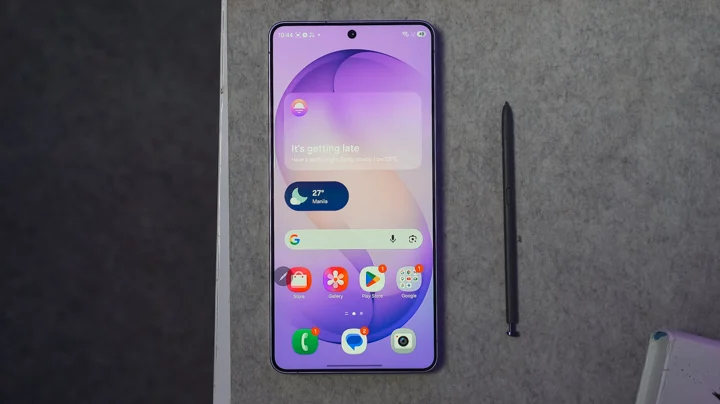
What we LIKED:
- Display quality w/ built-in Privacy display
- Performance
- One UI 8.5
- Battery Life
What we DIDN’T Like:
- Plus-size dimensions
- No more Titanium
- Phone wobbles without a case
- Incremental camera upgrades
Samsung Galaxy S26 Ultra specs:
6.9-inch QHD+ Dynamic AMOLED 2X Display
120Hz Dynamic refresh rate
One UI 8.5 (based on Android 16)
Qualcomm Snapdragon 8 Elite Gen 5 for Galaxy
12GB,16GB RAM
256GB, 512GB, 1TB Storage
Quad Rear Cameras:
200MP main
50MP ultrawide
10MP telephoto 3x optical zoom
50MP telephoto 5x optical zoom
12MP front camera
5,000mAh battery
Super Fast Charging 3.0 (60W)
Super Fast Wireless Charging
Wireless PowerShare
S-Pen
78.1 x 163.6 x 7.9mm
214g
Cobalt Violet, Sky Blue, Black, White, Silver Shadow, Pink Gold



0 Comments
Leave a Reply