

Performance and Benchmarks
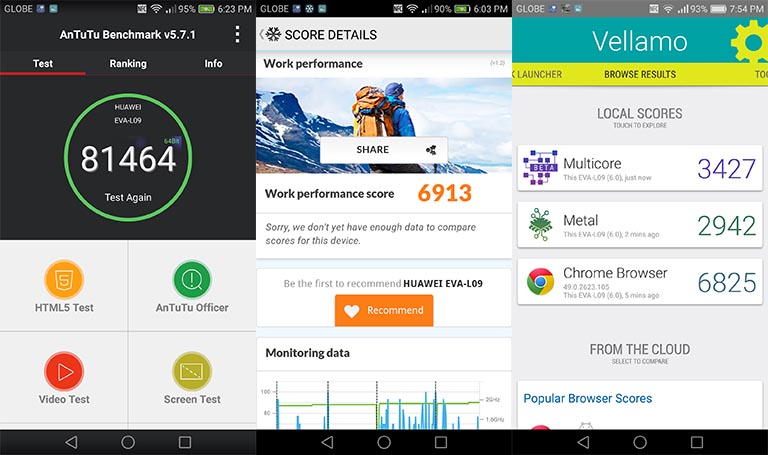
Camera aside, the P9 is no slouch in the processing department either. It is equipped with the company’s own HiSilicon Kirin 955 octa-core processor that’s previously reported to have beaten the 10-core Helio X20 SoC. In the graphics department, we have the Mali T-880 MP4 GPU.
There will be two variants once the P9 becomes available for purchase – 3GB RAM/32GB storage and 4GB RAM/64GB storage. What we have now is the former which is responsible for the following benchmark scores:
- AnTuTu – 81,464
- Quadrant Standard – 32,188
- Vellamo – 3,427 (Multicore), 2,942 (Metal), 6,825 (Chrome Browser)
- 3DMark – 891
- PCMark – 6,913
Although it’s got the muscle for processing resource-intensive tasks, we came across some minor bugs with its software during our time with it.
There was one time it just kept on vibrating for no apparent reason while we were using it and had to turn off the screen for it to stop. We also experienced Facebook crashing a couple of times when trying to switch to a different app to open an attachment.
It’s still a bit understandable at this point since the device that we have is one of the first units to be rolled out worldwide. Hopefully, they address these issues via OTA updates before they become available for purchase.
Other than that, we had no other problems using it for more than a week as our main phone.
Battery Life
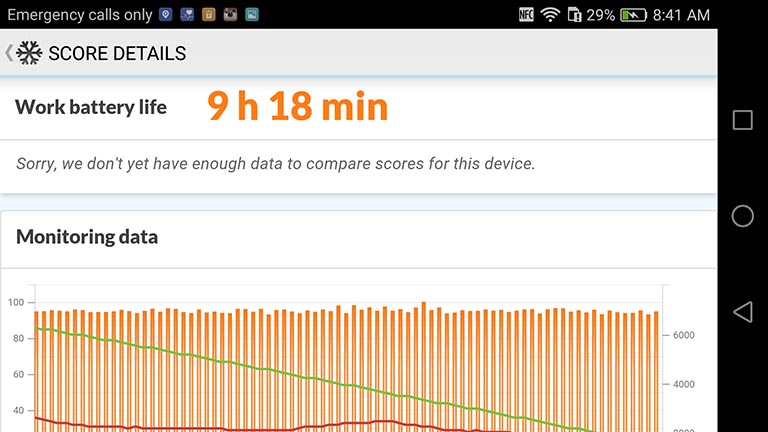
We subjected the P9 to our usual PCMark battery test which lasted for over 9 hours. However, during our video loop test that involves continuously playing a video on Airplane mode with 50% brightness and volume, it was only able to last for 6 hours and 18 minutes.
As for its real-life usage, its 3000mAh battery was just enough to last us one whole day before we needed to plug it again. Charging time from 3% takes about more than 2 hours before it’s fully charged.
Call Quality and Connectivity
We’ve also tried calling using the P9 and had no problems doing so. The quality of the voice from the other end was audible and loud enough, while we were clearly heard as well.
In terms of connectivity, this device has all the basic functions including Wi-Fi, Bluetooth, and even threw in NFC for easy wireless pairing. The speed using data connection via LTE was generally acceptable but still depends on your location.
Conclusion

The Huawei P9 is the kind of smartphone with a simple design and light body, yet attractive and easy to handle. The capabilities it offers its user in terms of imaging is undoubtedly impressive thanks to the dual rear cameras that produce images that are crisp, detailed, and natural. Plus, its monochrome mode positively adds a bit of drama to any shot.
Inside, it’s also packed with beefy components that could take on heavy tasks, but performance is sometimes hampered due to its immature software resulting to hiccups and random crashes.
Lastly, if only its battery has a bit more juice then we’ll be totally happy about it instead of only lasting for just a day (sometimes less). So it’s better to have a power bank around if you’re a heavy user.

Caught the sunset from above the clouds using the P9.
At the end of the day, we would say the Huawei P9 is a serious cameraphone for those who just want to be able to easily whip out their phone and take good pictures with.
It has some slight hiccups but if you’re okay with those and you think that Apple and Samsung smartphones are too common nowadays, then this could be the handset you’re looking for.
The P9 has an international price of 599 Euros (~Php31,500) for the 3GB RAM model, and 649 Euros (~Php34K) for the 4GB RAM variant. It will be available by April 16 in Europe and Middle East with no news for Philippine release just yet.
Huawei P9 specifications:
5.2-inch Full HD IPS display (1920 x 1080 pixels), 423ppi
2.5GHz Kirin 955 octa-core processor
Mali-T880 MP4 GPU
3GB / 4GB RAM
32GB / 64GB internal storage
Expandable via microSD, up to 128GB (uses SIM 2)
Dual 12-megapixel hybrid autofocus rear camera w/ dual-tone LED flash, Leica optics
8-megapixel front-facing camera
Dual SIM
LTE
Wi-Fi 802.11 ac, dual-band
Bluetooth 4.1
GPS w/ A-GPS, GLONASS, BDS
NFC
USB Type-C
Fingerprint scanner
3000mAh Li-Ion battery
Android 6.0 Marshmallow w/ Emotion UI 4.1
145 x 70.9 x 6.95 mm
144 g
What we liked about it:
- Slim and light form factor
- Premium design
- Dual Leica lenses produce impressive raws
- Monochrome mode for extra drama!
- Effective shooting modes
- Beefy processor
What we didn’t like:
- Software bugs
- Underwhelming battery life

Pretty fun to reread the comments to this