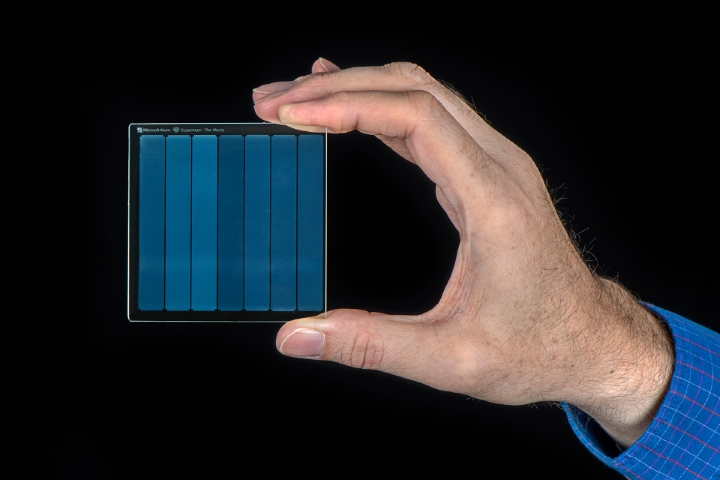

Microsoft Research recently introduced Project Silica, a storage technology that uses ultrafast laser optics to store data in quartz glass. Project Silica is designed and built for large-scale storage systems, including cloud infrastructure. A femtosecond laser (similar to the ones used in LASIK surgery) encodes data in glass and creates layers of three-dimensional nanoscale gratings and deformations at various depths and angles. Machine learning algorithms, then, read the data by decoding images and patterns that are created as polarized light shines through the glass. It is also seen as a new long-term storage solution as it has a lifespan of more than 1,000 years, unlike hard disk drives that can wear out after three to five years or magnetic tapes that can only last five to seven. Hard silica glass can also withstand being boiled in hot water, baked in an oven, microwaved, flooded, scoured, demagnetized, and other environmental threats. Glass storage also has the potential to become a lower-cost option because you only write the data onto the glass once. collaborated to successfully store and retrieve the entire 1978 “Superman” movie on a piece of glass roughly the size of a drink coaster, 75 by 75 by 2 millimeters thick. Read more in our articles including "Microsoft's Project Silica uses glass to store data" and "Microsoft working on Project Glass competitor".
Microsoft Research recently introduced Project Silica, a storage technology that uses ultrafast laser optics to…
Nov 10, 2019
Microsoft just revealed that they applied for a patent that features wearable glass technology, similar…
Nov 24, 2012Corning extends its glass technology to the PC market with the announcement of the Gorilla…
Jul 29, 2013
DJI has officially launched the Osmo Pocket 4P in the Philippines, introducing a new handheld…
Jun 29, 2026
Senator Paolo Benigno “Bam” Aquino IV has rejected calls for a blanket ban on video…
Jun 29, 2026
Simplus is celebrating its fifth anniversary in the Philippines with the launch of its “Live…
Jun 29, 2026Microsoft Research recently introduced Project Silica, a storage technology that uses ultrafast laser optics to store data in quartz glass. Project Silica is designed and built for large-scale storage systems, including cloud infrastructure.
A femtosecond laser (similar to the ones used in LASIK surgery) encodes data in glass and creates layers of three-dimensional nanoscale gratings and deformations at various depths and angles. Machine learning algorithms, then, read the data by decoding images and patterns that are created as polarized light shines through the glass. It is also seen as a new long-term storage solution as it has a lifespan of more than 1,000 years, unlike hard disk drives that can wear out after three to five years or magnetic tapes that can only last five to seven.
Our coverage of glass storage includes: "Microsoft's Project Silica uses glass to store data"; "Microsoft working on Project Glass competitor"; "Corning launches Gorilla Glass NBT for laptops". Each article provides unique insights and information.