

Performance and Benchmarks
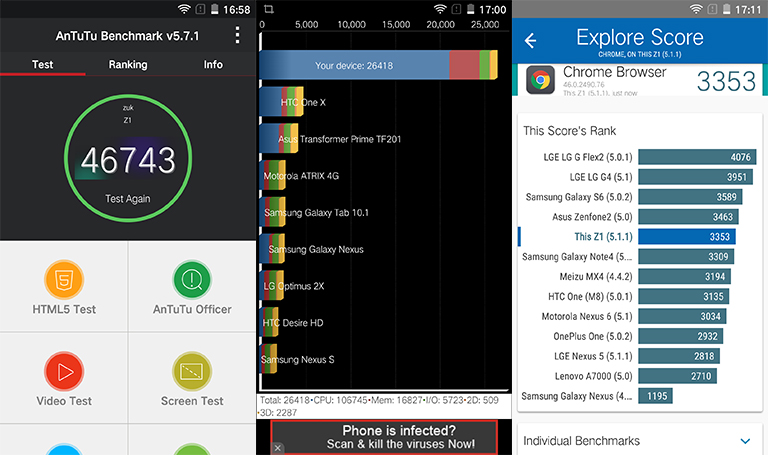
Powering the device is a Snapdragon 801 processor with 3GB RAM. It may be an older chip, but it is still capable of handling all you throw in the phone — even resource-heavy games such as Asphalt 8. The Z1 also gets a bit warm at the back, and mostly at the metal sides when you’re playing or doing intensive tasks by (up to 40.5°C on Du Battery Saver’s monitoring). We checked it with our benchmarks, and here’s what we’ve got:
* AnTuTu – 46,743
* Quadrant Standard – 26,418
* Vellamo – 3,353 (Chrome), 1,673 (Metal), 1,881 (Multicore)
* 3DMark – 18,756 (Ice Storm Unlimited)
Given that it has a processor from last year. the performance benchmarks in AnTuTu puts it on par with other powerful smartphones such as the Meizu MX4, Motorola Moto X, or even the ASUS Zenfone 2 ZE551ML.
Connectivity and Call Quality
Calls were good on the Z1. The call speakers produces clear sounds and the microphone is audible to be heard by the other party. Connectivity wasn’t an issue as well, as we got to be connected to a lot of wireless connections such as Wi-Fi, Bluetooth, and mobile data. Sadly, there no Dual LTE connectivity as only the SIM 1 tray can offer 4G signals, leaving the other on a lower mobile data signal capacity.
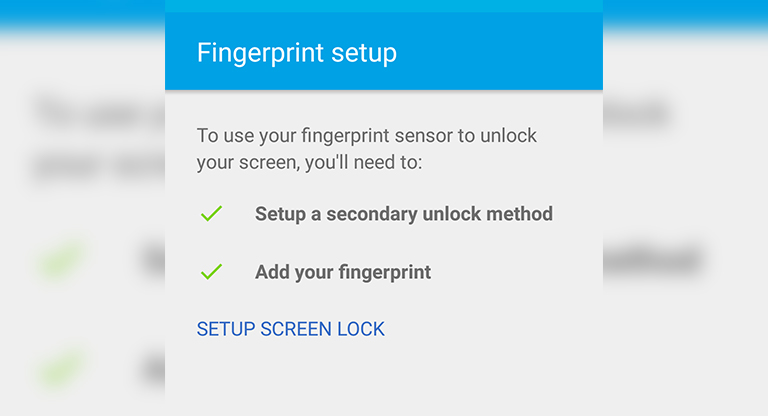
There’s also the fingerprint scanner, which happens to be a responsive one with a lot of added features in. The scanner works really well, even if you have to swipe your finger over the button instead of the touch imprint method used on other devices. The Z1, sadly, doesn’t have NFC, so you will have to go through the longer method of pairing to another device.
Transferring files from the phone to the PC using the USB-C port isn’t a hassle and takes a breeze. It’s a welcome treat for those looking for a new standard in wired connectivity, as it is reversible and you won’t have problems putting the cord in. You might have to buy additional cords due to the nature of the port itself: USB-C is not yet common for smartphones in the country, and you might need to bring a cord along with you every time due to its scarcity at the time of this writing.
Battery Life
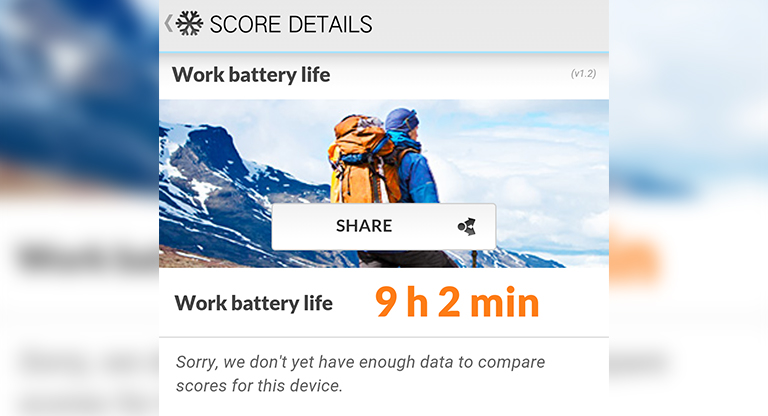
The Z1’s 4100mAh battery can get you through up to two days with light to moderate usage of calls, SMS, and internet browsing both on mobile data and Wi-Fi. Our PCMark test gave the ZUK Z1 a 9 hours and 2 minutes work battery life. Meanwhile, our standard video loop test kept the phone running for 13 hours and 20 minutes. With a 2A 5V quick charge adapter, charging the phone takes about two to three hours to full.
Conclusion
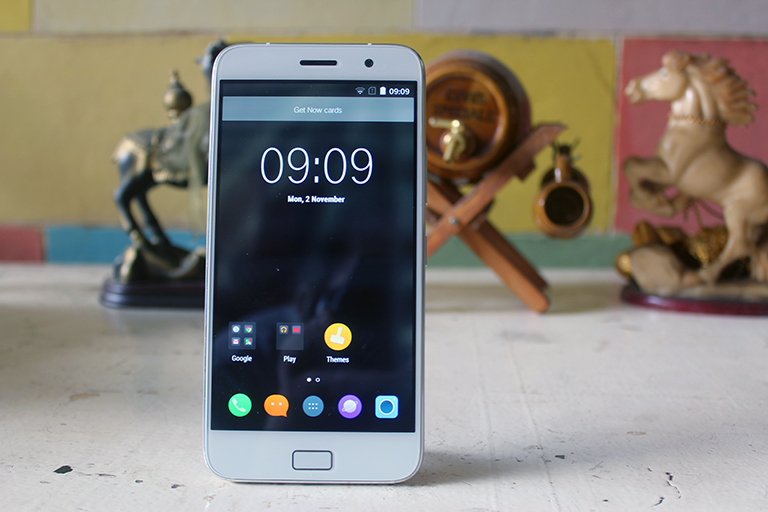
Combining a minimal yet mixed look and a software well-integrated to perform, the ZUK Z1 is poised to stand up against the competition as a bang-for-the-buck device. At Php15,299, you get to have a smartphone capable of offering great performance with good battery life and added features in tow.
With that being said, the absence of storage expansion via a microSD card slot may drive away users who prefer to expand the available storage. Its non-removable back is susceptible to fingerprints and smudges. Nevertheless, the phone is great for those who need a capable SD801-equipped phone with great battery life at a price less than that of the flagships.
ZUK Z1 specs:
5.5-inch Full HD IPS display @ 1920 x 1080 resolution, 401ppi
2.5GHz Quad-core Snapdragon 801 quad-core processor
3GB RAM
64GB internal storage
13MP rear camera with f/2.2 aperture, IMX214 sensor, dual-tone LED flash, OIS
8MP front camera with OV8865 sensor
Dual-SIM (nano)
4G LTE
USB Type-C and USB 3.0
4100mAh battery w/ fast-charging tech
U-Touch fingerprint reader
8.9mm thick
Cyanogen OS 12.1 (based on Android 5.1.1)
What we liked about it:
* Good display even in outdoor environments
* Good battery life
* Great performance
* USB-C
* Cyanogen offers great customization options
* Well-responsive fingerprint reader
What we didn’t like about it:
* Device is a fingerprint and smudge magnet
* No expansion storage available

nice so ganda naman nyan edi wOw! malina camera hahahaha bibili ako nyan ma try nga..