

Performance and Benchmarks
Since the Moto E has no skin or theme on top of Android, you can expect a smooth performance throughout. Navigation around the UI or menus is fluid and animations are shown with no lag. Since it only has 1GB of RAM, hiccups are present when multi-tasking, particularly when you’ve been using the device for hours without closing any unnecessary apps that are still running in the background. If there’s one thing that a Vanilla Android lacks is a one-click dismissal of opened apps. Good thing the Play Store has you covered with some nifty apps to take care of that.
Aside from that, we had an issue with the Moto E during our initial setup. We updated the Google apps upon unboxing and encountered a serious error that appears to cause trouble with all the installed apps. We tried cache clearing and few options found online, but the problem was still present. We then resorted to a factory reset and started from scratch. After that, things were back to normal and the error was gone even after we re-updated the apps.
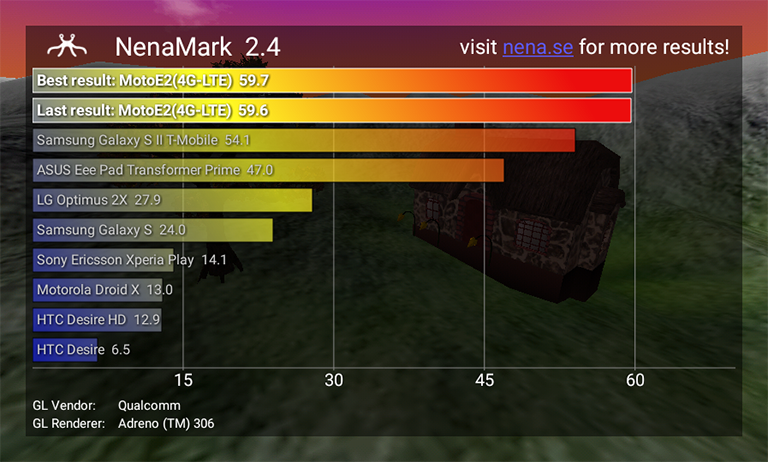
Of course, we did our usual benchmark tests on the device to see how it fares against most smartphones through numbers. Here are the results:
-
Quadrant Standard – 13,881
Antutu Benchmark v5 – 21,912
Nenamark 2 – 59.7 fps
PCMark Android – 2,559
Vellamo – 1,828 (Chrome), 1,095 (Multicore), 807 (Metal)
Connectivity and Call Quality
There are two micro SIM card slots with LTE capability. Like most dual SIM smartphones, only one network can use 4G for data connectivity at a time. You can also set which SIM card you’d like to use primarily for calls and text messaging. Bluetooth and Wi-Fi is onboard as well however there’s no NFC.

The large earpiece produces clear voice output during native phone calls and thanks to the noise-cancelling microphones, the recipient can hear us properly even under a noisy environment. Signal reception has been strong most of the time.
Battery Life
Powered by a 2,390mAh Li-Ion battery, longevity is expected from this smartphone. We were able to use the Moto E for a full working day before reaching 15%, thus activating battery saver. That is with calls and texts, data usage to check Facebook and road traffic, plus playing solitaire while stuck along EDSA. We also managed to get 11 hours and 7 minutes through our video loop test with 1080p video at half brightness, zero volume, and under airplane mode. While another battery test standard, PCMark, scored the Moto E with 10 hours and 24 minutes.
Conclusion
Categorized as a budget offering from Motorola, the Moto E has advantages over similar devices in terms of software, support, and trust. It carries the brand proudly and boasts Android to perform well without having monster specifications. With a price tag of Php 6,990, which is steeper compared to competing phones, you’ll get a clearly packaged smartphone and established Motorola experience.
Motorola Moto E specifications:
4.5-inch IPS LCD display @ 540 x 960 pixels
1.2GHz Snapdragon 410 quad-core processor
Adreno 306 GPU
1GB RAM
8GB internal storage, up to 32GB via microSD
5-megapixel rear camera, 720p @ 30fps
VGA front-facing camera
Dual-SIM, Dual-standby
4G LTE
Wi-Fi 802.11 b/g/n
Bluetooth 4.0
GPS, A-GPS
Android Lollipop
2,390mAh Li-Ion battery
129.9 x 66.8 x 12.3 mm
145g
1.2GHz Snapdragon 410 quad-core processor
Adreno 306 GPU
1GB RAM
8GB internal storage, up to 32GB via microSD
5-megapixel rear camera, 720p @ 30fps
VGA front-facing camera
Dual-SIM, Dual-standby
4G LTE
Wi-Fi 802.11 b/g/n
Bluetooth 4.0
GPS, A-GPS
Android Lollipop
2,390mAh Li-Ion battery
129.9 x 66.8 x 12.3 mm
145g
What we liked about it:
- Superb build
- Great display
- Long battery life
- LTE connectivity
What we didn’t:
- Mediocre camera
- Software quirks
- Slow charging


Android 6.0 OTA upgrade is now available for 2nd gen LTE (XT1521)!