

Last week, we finally decided to buy the HTC Butterfly so we can make an early review of the unit on our own. For the past several days, we’ve been using it as a primary phone but what impressed us the most are the scores in our synthetic benchmarks.
We had our first impressions with the HTC Butterfly a couple of weeks ago here and before we publish our full review, we’d like to share with you the benchmark scores first.

These scores reflects more on the performance of the new Qualcomm Snapdragon S4 Pro chip. Three of the most common benchmark tools that we use here measures the number-crunching powers of the CPU, the speed of the GPU in pushing pixels to the screen and the over-all performance of the other main components (RAM speed, read/write speed of internal storage, etc)
First off is Nenamark 2. The HTC Butterfly scored 59.5fps which looks like a typical frame rate offered by many other handsets before it.
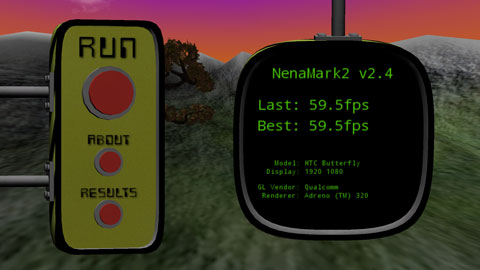
However, consider that this unit is pushing more than twice the number of pixels per frame. At 1080p, it processes over 2 million pixels per frame compared to your other 720p HD displays which only has about 920k pixels per frame. That means we get an effective performance increase of at about 100%.
Next up are the Quardrant scores and the Antutu Benchmark score.

For Quadrant, the device scored a high of 8,014 (the first one we’ve seen to hit the 8k mark) while Antutu Benchmark score is an unbelievable 20,085 (first one to get above 20k mark).
The last time we saw really high benchmark scores were with the HTC One X+ (Quadrant: 7,195; Antutu: 16,173) and the Samsung Galaxy Note 2 (Quadrant: 6,592; Antutu: 13,540)

Of course, these are just numbers and don’t really reflect actual real-world performance. At least the numbers can somehow give us some sort of a relative comparison with the other flagship phones.
Watch out for our full review of the HTC Butterfly by end of the week.






LG and HTC on both corner. Whew. What a nag?
I really look forward having HTC. Ang astig ng dating, even not mentioning the performance.