

Performance and Benchmarks
Powered by a Snapdragon 410 quad-core CPU, 2GB RAM, and Adreno 306 GPU, the Max proved to be a solid performer. Although it doesn’t have a lot to boast when it comes to benchmark numbers, it can get through tasks without choking. We played EA UFC and it was able to run well with minimal lags and without much warming.

- AnTuTu – 23,246
- Quadrant Standard – 14,518
- Vellamo – 998 (Multicore), 620 (Metal), 1,467 (Chrome Browser)
- 3DMark Sling Shot ES 3.0 – 51
- PCMark – 2,347
Connectivity and Call Quality
The Max comes with your usual connectivity features like 4G LTE, dual-SIM (micro), WiFi, Bluetooth, and GPS. There’s no NFC, but not really a huge let down. Both SIM card slots support mobile data and dual-SIM call forwarding. The call quality is good and has no problems connecting to mobile data as long as strong reception is available.
Battery Life
Now, for the part that you probably went here for — the Zenfone Max’s battery life. After running our usual battery benchmarking app, we were able to exhaust its 5000mAh battery for 19 hours and 59 minutes. Then on our video loop test that involves playing an HD video continuously with 50% volume and brightness and on Airplane Mode, it was able to last 26 hours and 32 minutes of continuous playback.
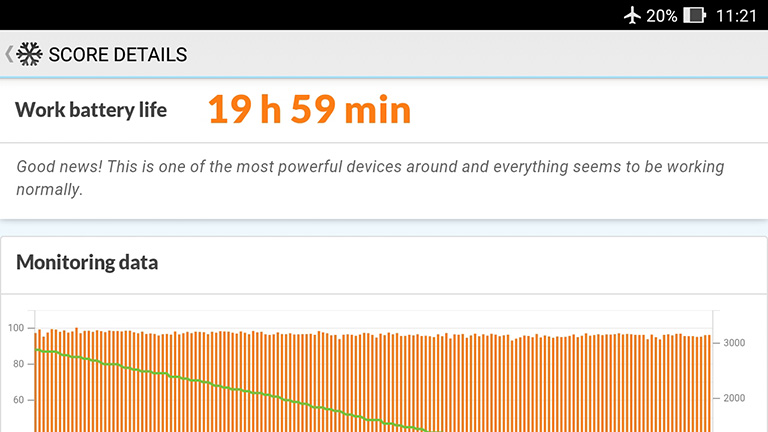
On the other hand, real-world usage got us up to almost three days which includes frequent checking of social media sites on LTE connectivity, some calls, and even charging other devices in between (with the use of a USB-OTG cable).
Although, with its included charger, refilling its large battery from 20% – 100% took us about 9 hours of charging time. Using a fast charger from a different device, however, lowered the duration to 4-5 hours before it was fully loaded once again.
Conclusion
The ASUS Zenfone Max indeed is what you would want if you’re tired of being a wall-hugger. We’ve mentioned before that a feature-packed smartphone is of no use when the battery’s dead, and the Max has plenty in store. It’s also got the imaging capabilities of the Laser, so it would be an ideal device for those who shoot a lot, whether photos or videos.
Its capability to charge other devices makes it a good second phone, too, since it’s not that expensive. For Php8,495, you’d most likely leave your power banks at home since the handset is reliable and less likely to give up on you when you’re on-the-go.

ASUS Zenfone Max (ZC550KL) specifications:
5.5-inch HD IPS display @ 1280 x 720 resolution, 267ppi
Gorilla Glass 4
64-bit 1.2GHz Snapdragon 410 quad-core processor
Adreno 306 GPU
2GB RAM
16GB internal storage
Expandable up to 128GB via microSD
13MP rear camera with f/2.0 aperture, laser autofocus, and dual-tone LED flash
5MP front camera with f/2.0 aperture
GPS, A-GPS, GLONASS
Bluetooth 4.0, A2DP, EDR
Wi-Fi 802.11 b/g/n, Wi-Fi Direct, Hotspot
Dual-SIM, dual standby
4G LTE
5000mAh Li-Po battery
156 x 77.5 x 10.6mm
202 grams
Android 5.0 Lollipop with ZenUI
What we liked about it:
* Good design and build
* Good camera w/ Laser AF
* Lots of built-in camera features
* Decent performance
* Exceptional battery life
* Affordable price
What we didn’t like:
* Lots of pre-installed apps
* UI looks clunky
* Low usable storage

Its an important message for all our viewers and audience. Please compare prices, Specifications, and reviews before buying any product. Else admin is taking an appreciable Initiative. please do not take it as wrong comment. thanks